Doenjang vs Miso: Understanding Korea and Japan's Fermented Soybean Pastes
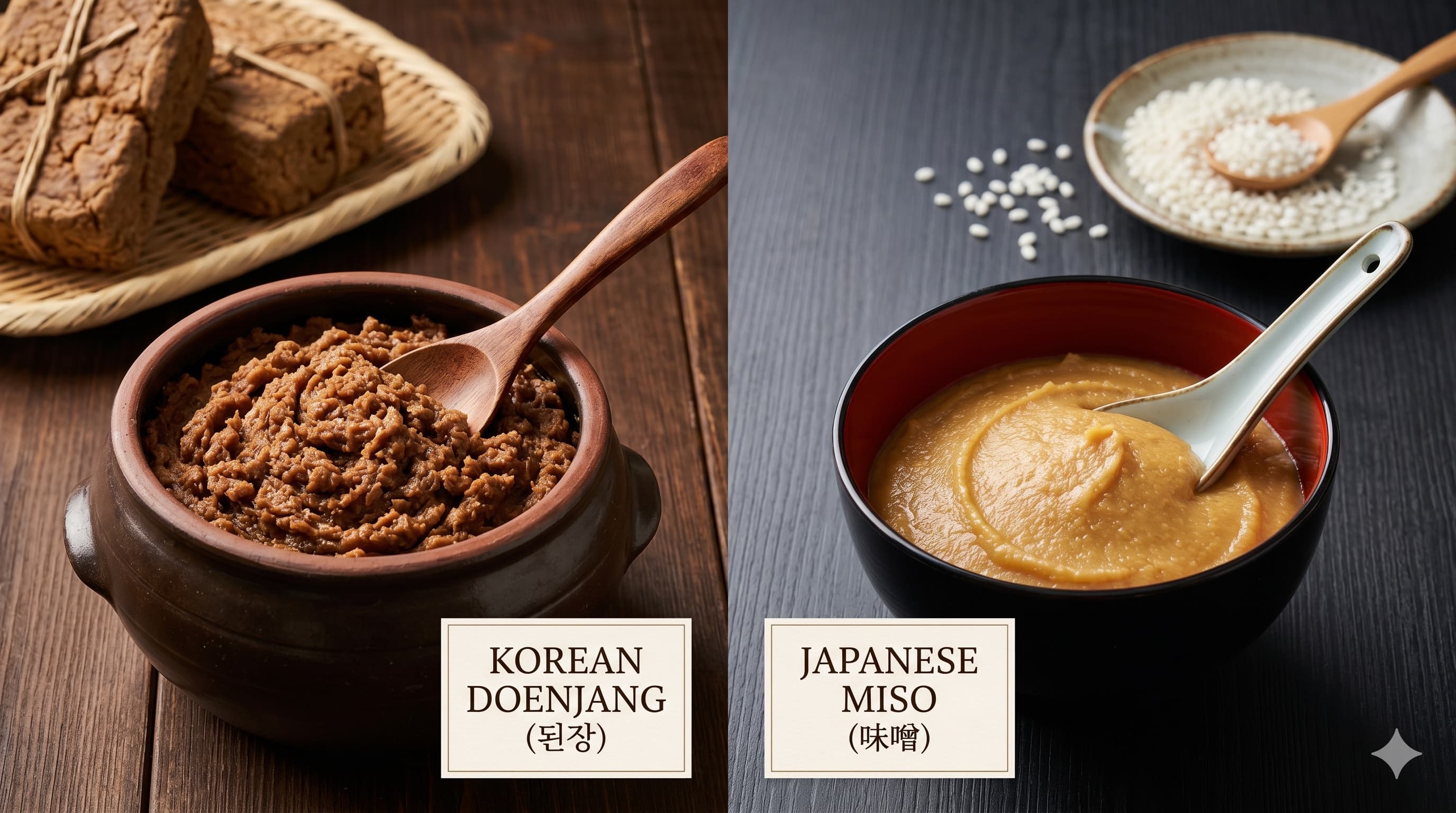
Two Pastes, Two Traditions
To the uninitiated, Korean doenjang and Japanese miso might seem interchangeable — both are fermented soybean pastes used to make soup and season food. But spend time with both, and the differences become clear. They are cousins, not twins — related by history but shaped into distinct products by different fermentation methods, microbial cultures, and culinary philosophies.
How Doenjang Is Made
Traditional Korean doenjang follows a process developed over many centuries:
- Meju formation: Cooked soybeans are mashed and shaped into large blocks (meju), then hung to dry in open air for weeks. Wild bacteria and mold (primarily Bacillus subtilis and Aspergillus oryzae) colonize the blocks naturally from the environment
- Brine fermentation: Dried meju blocks are submerged in salt brine in onggi (earthenware crocks) and left in sunlight for 2-3 months
- Separation: The liquid is drained off to become ganjang (Korean soy sauce), while the solids become doenjang
- Further aging: Doenjang continues fermenting for months to years, developing deeper flavor
The key characteristic: doenjang relies on wild, ambient microorganisms and undergoes a long, two-stage fermentation. No grain is added to the soybeans.
How Miso Is Made
Japanese miso uses a controlled, single-stage fermentation:
- Koji preparation: Rice, barley, or soybeans are inoculated with a pure culture of Aspergillus oryzae (koji mold) in carefully controlled conditions
- Mixing: Koji is combined with cooked soybeans and salt
- Fermentation: The mixture ferments in sealed containers for weeks to years depending on the variety
The key difference: miso uses cultivated koji as its fermenting agent and typically incorporates grain (rice koji for white/red miso, barley koji for mugi miso). The fermentation is a single continuous process.
Flavor Profiles
Doenjang: Bold, pungent, deeply funky. It has a rougher, more assertive character — what Koreans describe as gupsu (구수하다), a unique word for the savory depth of fermented soybeans. The flavor is concentrated, almost aggressive, and holds up well to strong cooking and long simmering.
Miso: More refined and varied. White miso (shiro) is sweet and delicate. Red miso (aka) is saltier and more complex. Overall, miso tends toward smoother, more rounded flavors that complement rather than dominate.
Nutritional Comparison
Both are nutritionally excellent fermented foods. However, because doenjang is made from pure soybeans without grain dilution, it typically has higher protein content per serving. Both provide probiotics, though the specific bacterial strains differ due to their different fermentation methods. Both are rich in isoflavones, though doenjang's longer fermentation may produce more bioactive forms. Both are high in sodium — a tablespoon of either provides significant sodium, so moderation is appropriate.
Culinary Uses: When to Use Which
Use doenjang when:
- Making Korean stews (jjigae) — its bold flavor stands up to long cooking
- Creating dipping sauces (ssamjang) for raw vegetables and wraps
- Seasoning hearty soups that need assertive flavor
- Braising root vegetables or tofu that benefit from deep, funky savoriness
Use miso when:
- Making quick soups meant to be delicate (miso soup should not boil)
- Creating salad dressings or light sauces
- Glazing vegetables where you want sweetness and subtlety (like miso-glazed eggplant)
- Adding umami to dishes without overwhelming other flavors
Can You Substitute One for the Other?
In a pinch, yes — but the results will differ. Red miso is the closest substitute for doenjang, though it will taste smoother and less complex. If substituting miso for doenjang in a Korean recipe, use a bit more and consider adding a splash of soy sauce for depth. Substituting doenjang for miso in a delicate Japanese soup will produce a much bolder, funkier result — reduce the amount and simmer briefly rather than adding at the end.
Ultimately, both deserve a place in your pantry. They serve different purposes and inspire different cuisines — and together, they demonstrate the extraordinary range that fermented soybeans can achieve.