Ethical Veganism from a Buddhist Perspective: Beyond Just Diet
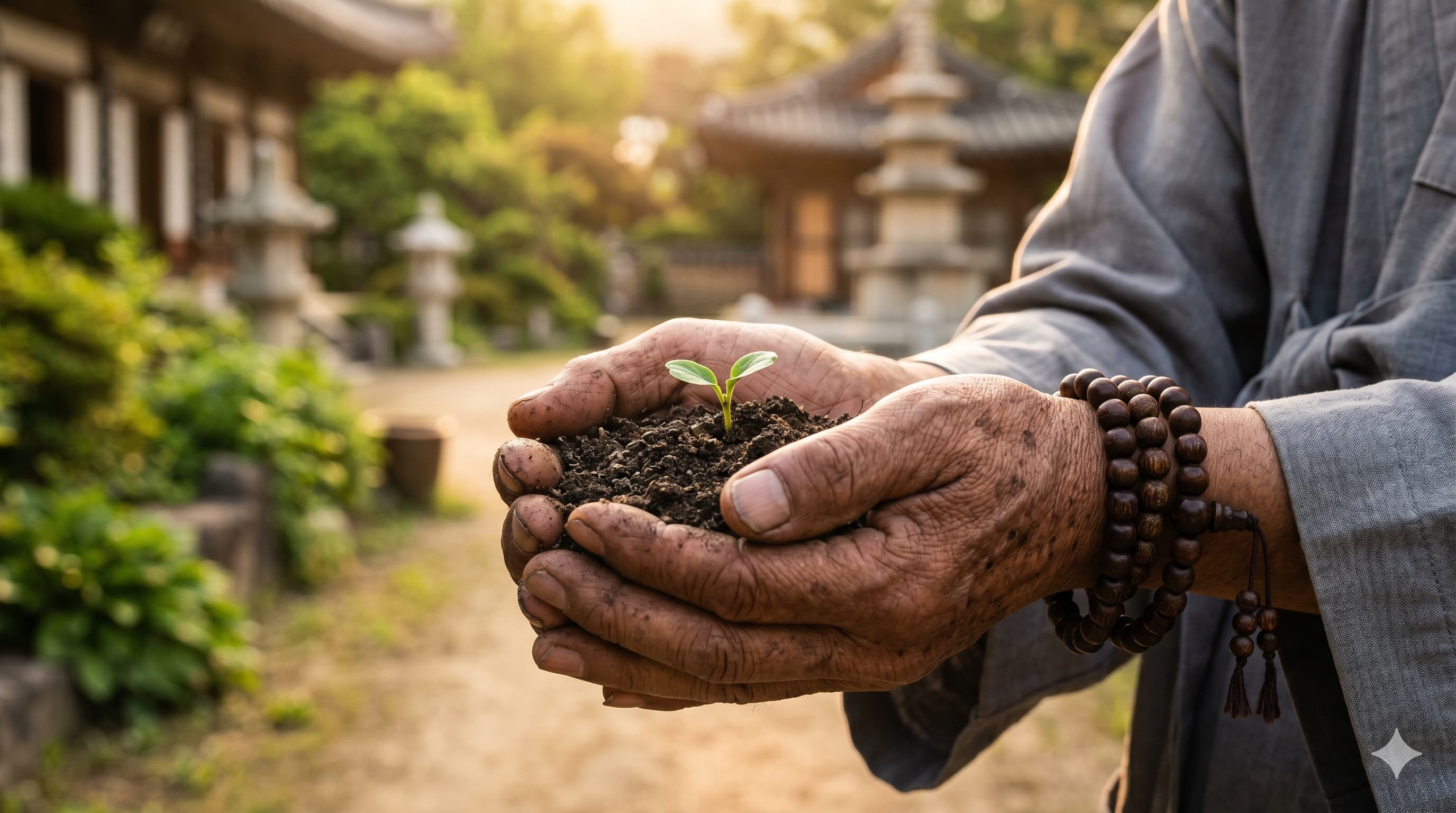
Beyond the Plate: Ethics as a Way of Life
Modern veganism often begins with food — the decision to stop eating animal products. But Buddhist ethical veganism has always understood this choice as merely one expression of a much broader commitment. In Korean Buddhist practice, the way one eats is inseparable from the way one lives, consumes, relates to others, and inhabits the world. Food is the entry point, not the destination.
The Foundation: Interconnection (연기, Yeongi)
The Buddhist concept of yeongi (연기) — dependent origination or interconnection — teaches that nothing exists independently. Every being, every object, every moment arises in dependence upon countless causes and conditions. A single meal connects you to the farmer who grew the grain, the rain that nourished it, the sun that powered photosynthesis, the soil organisms that maintained fertility, and every being affected by the land use that produced your food.
This understanding transforms consumption from a private act into an ecological and ethical one. When you truly perceive interconnection, the question is not merely "does this food contain animal products?" but "what is the full web of impact created by my choices?"
Non-Harm Extended: Leather, Silk, and Beyond
Korean Buddhist monastics extend the precept of non-harm (불살생) beyond diet to all aspects of material life:
- Clothing: Traditional monastic robes are made from plant fibers (cotton, hemp, ramie). Leather, silk, wool, and down are avoided as they require animal exploitation or death
- Daily implements: Temple items are made from wood, clay, metal, and plant fibers — not bone, horn, or animal-derived materials
- Cleaning products: Temple kitchens clean with natural, plant-derived materials — rice bran for scrubbing, wood ash for degreasing, herbal infusions for sanitizing
- Gardening: Temple gardens practice non-violent cultivation — no pesticides that kill insects, manual weeding, companion planting for pest management
This comprehensive approach predates the modern "vegan lifestyle" movement by many centuries, demonstrating that ethical consistency has been practiced and refined in Korean Buddhist communities for over a millennium.
Mindful Consumption: The Middle Way
Buddhist ethics do not demand asceticism or self-punishment. The Middle Way (중도, jungdo) teaches balance — enough for health and practice, not excess driven by craving. In Korean temple life, this manifests as:
- Sufficiency over abundance: Owning few possessions, each well-made and carefully maintained
- Quality over quantity: Choosing durable, repairable items rather than disposable ones
- Need over want: Distinguishing genuine necessity from desire-driven consumption
- Gratitude over entitlement: Receiving everything — food, shelter, clothing — as a gift rather than a right
This framework offers modern vegans a valuable complement to dietary choices. Ethical living is not just about what you avoid but about cultivating a relationship with consumption that is conscious, grateful, and restrained without being punitive.
The Practice of Barugongyang: Ethics Made Tangible
The formal monastic meal practice of barugongyang (발우공양) embodies Buddhist ethical principles in every detail:
- Taking only what you will eat: Teaches awareness of actual need versus habitual excess
- Cleaning bowls with water you then drink: Ensures zero waste and demonstrates that nothing is beneath you
- Eating in silence: Removes the social performance aspects of eating, returning to pure nourishment
- Chanting gratitude: Acknowledges the labor and sacrifice (of plants, elements, and workers) behind every grain
Practiced daily, this ritual trains ethical awareness at a bodily level. It is not philosophy abstract from life — it is philosophy lived three times a day.
Compassion Beyond Species
Korean Buddhist thought extends compassion (자비, jabi) to all sentient beings without hierarchy. The Avatamsaka Sutra, deeply influential in Korean Buddhism, describes reality as an infinite net of jewels (인드라망, Indramang) where each jewel reflects all others — a metaphor for the radical interconnection of all life. In this view, causing suffering to any being diminishes the whole, including oneself.
This perspective avoids the anthropocentrism that often undermines ethical arguments. It does not ask "are animals similar enough to humans to deserve moral consideration?" Instead, it recognizes that all sentient beings share the capacity for suffering and the desire for happiness — and that this alone is sufficient ground for compassion.
Applying Buddhist Ethics in Modern Life
You need not be Buddhist to draw wisdom from these principles. Practical applications include:
- Before purchasing: Ask "who or what was harmed in producing this?" — extending attention beyond food to clothing, electronics, cosmetics
- Reducing overall consumption: Recognizing that the most ethical product is often the one not purchased at all
- Practicing gratitude: Before each meal, take a moment of awareness for the chain of beings and conditions that brought food to your table
- Extending kindness: Practice non-harm not only toward animals but toward all people, including those you disagree with — the Buddhist framework resists the anger and judgment that sometimes characterizes activist movements
- Embracing imperfection: The Middle Way acknowledges that perfection is impossible. What matters is direction, intention, and consistent effort — not purity
A Living Tradition
Korean temple food practices are not museum relics but living, evolving traditions maintained by thousands of monastics today. They demonstrate that ethical veganism — comprehensive, principled, and joyful — is not a modern invention but an ancient path. In a world increasingly aware of the costs of exploitation and excess, this 1,700-year experiment in compassionate living offers not just inspiration but proven, practical wisdom.