Korean Buddhism and Veganism: A 1,700-Year Tradition of Compassion
Buddhism Arrives in Korea
Buddhism was officially introduced to the Korean peninsula in 372 CE, when a monk named Sundo arrived in the Goguryeo kingdom from northern China, bringing sutras, images, and the dharma. Within two centuries, Buddhism had become the dominant spiritual and intellectual tradition across all three Korean kingdoms. With it came the precept of ahimsa — non-violence toward all sentient beings — and the dietary practices that embody this principle.
The Precept of Non-Killing (불살생, Bulsalsaeng)
The first of the five fundamental Buddhist precepts is bulsalsaeng (불살생) — the vow not to kill or cause harm to living beings. In Korean Buddhist practice, this precept extends comprehensively to diet. It is not merely the avoidance of meat but a positive commitment to sustaining life through how one eats. Korean monks understand food production as an interconnected web — if eating requires another being's suffering or death, it violates the foundational commitment of Buddhist practice.
This understanding predates modern veganism by over a millennium. While the term "vegan" was coined in 1944, Korean Buddhist monastics had been living this principle since the 4th century — not as a dietary trend but as an inseparable aspect of spiritual cultivation.
The Seon Tradition and Mindful Eating
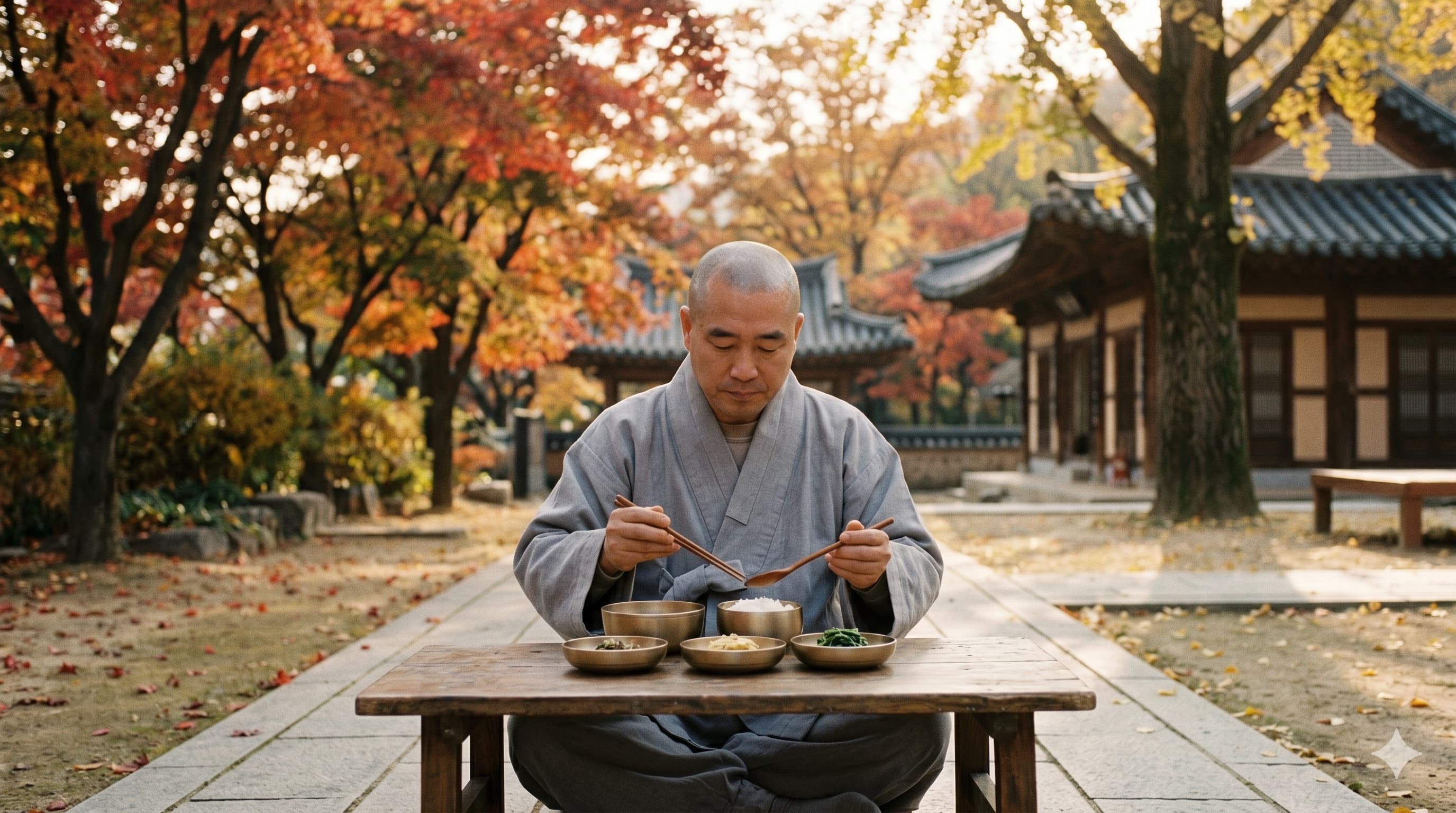
Korean Buddhism is predominantly Seon (선) — the Korean branch of Chan/Zen Buddhism — which emphasizes direct experience and mindfulness in every activity. In Seon monasteries, eating is not a break from practice; it is practice. The formal monastic meal, called barugongyang (발우공양), transforms eating into a meditation:
- Monks eat in silence from a set of nested bowls (baru)
- Food is received with gratitude for the labor of countless beings
- Every grain of rice is consumed — nothing is wasted
- Bowls are cleaned with water that is then drunk, leaving no residue
- The meal begins and ends with chanting that acknowledges interconnection
This practice cultivates awareness of food's origins, the labor behind it, and one's own relationship to consumption. It stands in stark contrast to modern eating habits characterized by distraction, excess, and disconnection from food sources.
Temple Food as Living Dharma
Korean temple food (사찰음식, sachal eumsik) is not simply "what monks eat." It is dharma expressed through cuisine — Buddhist teaching made tangible and edible. Every aspect embodies core principles:
- Compassion: No being suffers for the meal to exist
- Interdependence: Ingredients are understood as arising from sun, rain, soil, and countless conditions
- Impermanence: Seasonal cooking honors nature's constant change
- Non-attachment: Simple seasoning and preparation avoid stimulating craving
- Generosity: Food is shared freely with all who visit the temple
Historical Development Through Korean Dynasties
During the Goryeo Dynasty (918-1392), when Buddhism was the state religion, temple food culture flourished. Monasteries maintained vast kitchen gardens, developed sophisticated fermentation techniques, and created the hundreds of preparations that form the temple food canon today. Royal and aristocratic cuisine influenced temple kitchens, and vice versa.
The Joseon Dynasty (1392-1910) suppressed Buddhism in favor of Neo-Confucianism, pushing monasteries into remote mountain locations. This isolation paradoxically enriched temple food — monks developed expertise in wild mountain plants (san-namul), natural fermentation without commercial ingredients, and extreme preservation techniques that allowed communities to thrive in harsh conditions.
Modern Revival and Global Recognition
Since the late 20th century, Korean temple food has experienced a remarkable revival. The Korean government established the Temple Food Center in Seoul. Venerable Jeong Kwan gained international fame through Netflix's Chef's Table. Temple stay programs now welcome thousands of international visitors annually. UNESCO has recognized the tradition's cultural significance.
This revival arrives at a moment when the world urgently needs exactly what temple food offers: a proven, delicious, nutritionally complete plant-based cuisine with deep cultural roots and philosophical coherence.
What Temple Food Teaches Modern Veganism
Korean Buddhist food practice offers modern vegans something often missing from contemporary plant-based discourse: a complete philosophical framework. It connects the act of eating to ethics, ecology, health, mindfulness, and spiritual growth. It demonstrates that plant-based eating need not be defined by what it removes but by what it cultivates — compassion, awareness, gratitude, and connection to the living world.