Korean Rice Varieties and Their Health Benefits
Rice: The Heart of the Korean Table
In Korean cuisine, rice is far more than a side dish. It is the center of the meal, the word bap (밥) serving double duty to mean both "cooked rice" and "meal" itself. When Koreans greet one another, the traditional question is not "How are you?" but "Have you eaten rice?" (Bap meogeosseo?). This deep cultural reverence for rice extends to the extraordinary variety of grains cultivated across the Korean peninsula, each chosen not only for flavor and texture but for specific health properties recognized by centuries of traditional medicine.
Unlike the Western tendency to treat rice as a uniform commodity, Korean food culture distinguishes between dozens of rice types, often blending them to create japgokbap (잡곡밥), or mixed grain rice. The Donguibogam, Korea's foundational medical text written by Heo Jun in 1610, devotes significant attention to the therapeutic properties of different grains, viewing them as the foundation of daily health maintenance rather than mere sustenance.
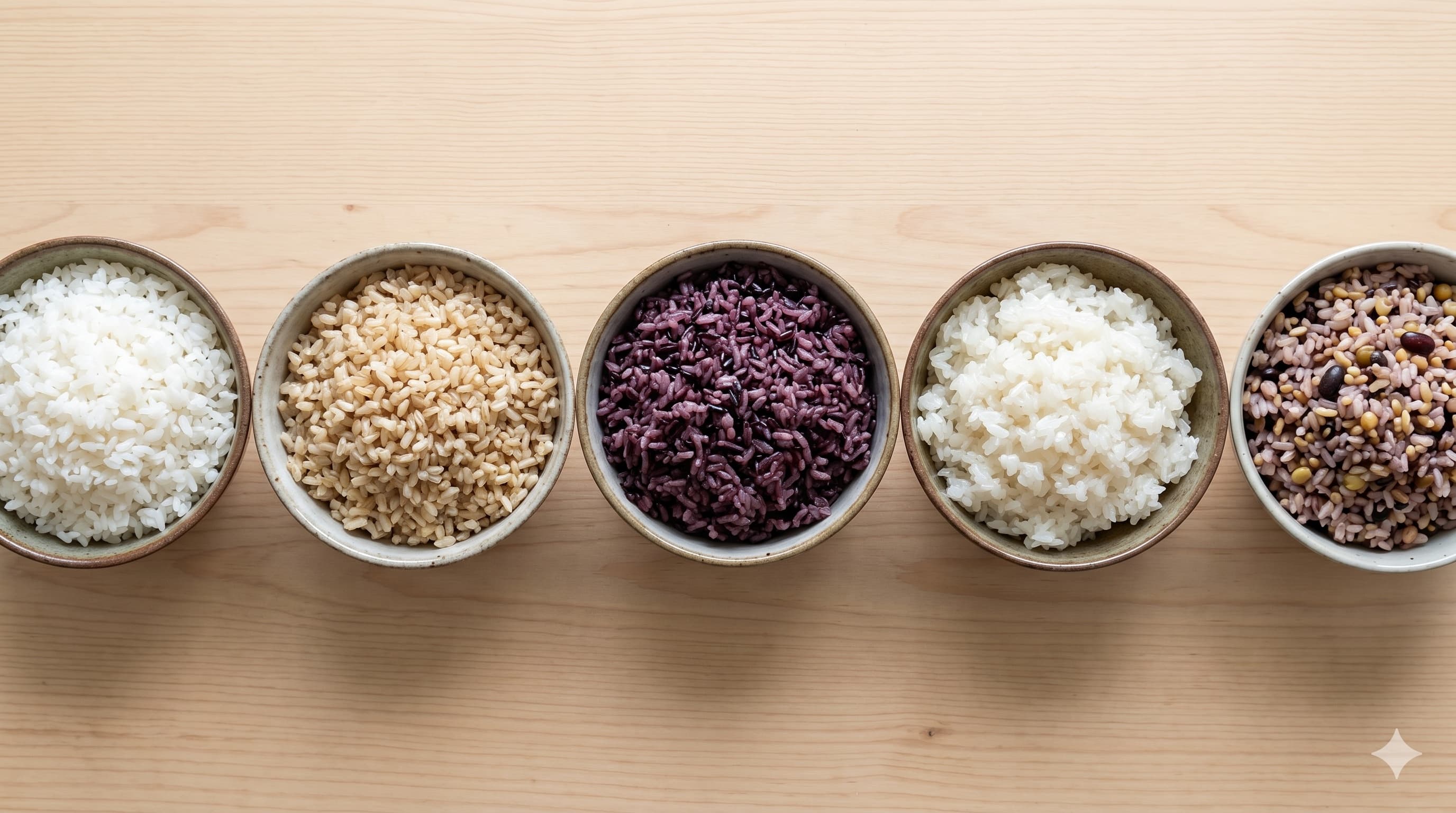
White Rice (Baekmi / 백미)
Polished white rice remains the everyday staple in most Korean households. Short-grain japonica varieties are preferred for their sticky, slightly sweet character that holds together well for eating with chopsticks. While white rice has been criticized in modern nutrition for its lower fiber content, the Donguibogam notes that it is gentle on the stomach, easy to digest, and appropriate for those recovering from illness or with weak digestive systems.
Korean white rice differs from long-grain varieties common in Southeast Asian cooking. The short, plump grains become glossy and slightly adhesive when cooked, creating the perfect base for soaking up the flavors of banchan, stews, and fermented pastes. For the healthiest approach, many Korean cooks now mix white rice with one or more whole grain varieties, getting the best of both worlds.
Brown Rice (Hyeonmi / 현미)
Brown rice retains its bran and germ layers, giving it a tan color and nutty, chewy texture. It provides significantly more fiber, B vitamins, magnesium, and manganese than white rice. In traditional Korean medicine, brown rice is considered warming and strengthening, beneficial for building gi (기, vital energy). It is recommended for people who need sustained energy and improved digestion.
Many Korean households soak brown rice overnight or for several hours before cooking to soften the bran layer. Some cooks use a pressure cooker to achieve tender results. A popular approach is to mix brown and white rice at a 1:1 or 1:2 ratio, easing the transition for those accustomed to the softer texture of polished rice. Brown rice is also sprouted (bal-a hyeonmi, 발아현미), which activates enzymes, increases GABA content, and makes nutrients more bioavailable.
Black Rice (Heukmi / 흑미)
Also known as "forbidden rice" because it was once reserved for royalty in ancient China and Korea, black rice gets its dramatic purple-black color from anthocyanins, the same powerful antioxidants found in blueberries and purple cabbage. The Donguibogam associates black-colored foods with the kidneys and the water element, recommending them for strengthening kidney function and nourishing the blood.
Black rice has a slightly sweet, almost floral flavor and a satisfying chewiness. When mixed into white rice, even a small handful transforms the pot into a beautiful purple-hued bowl. Korean cooks commonly add two to three tablespoons of black rice per cup of white rice. Beyond its visual appeal, black rice contains more protein and iron than white or brown rice, making it particularly valuable in plant-based diets. It is also used to make heukmi-cha, a toasted black rice tea believed to support circulation.
Mixed Grain Rice (Japgokbap / 잡곡밥)
Perhaps the most nutritionally complete approach to Korean rice is japgokbap, a mixture that might include five, ten, or even sixteen different grains and legumes. Common additions include barley (bori), millet (jo), sorghum (susu), Job's tears (yulmu), red beans (pat), black beans (geomeun kong), and various types of glutinous and non-glutinous rice.
This tradition reflects the Korean philosophical emphasis on balance and harmony. The Donguibogam teaches that consuming a variety of grains ensures that all five organs receive proper nourishment. Each grain is associated with a different organ system and elemental energy. By eating them together, one maintains equilibrium. Modern nutrition science supports this wisdom: combining grains with legumes creates complete amino acid profiles, and the diversity of fibers supports a healthy gut microbiome.
Glutinous Rice (Chapssal / 찹쌀)
Glutinous or "sticky" rice contains a high proportion of amylopectin starch, giving it an exceptionally sticky, chewy texture. Despite the name, it contains no gluten. In Korean cooking, glutinous rice is essential for making tteok (rice cakes), yakbap (sweet rice with nuts and dried fruit), and various festive dishes. The Donguibogam describes glutinous rice as warming and tonifying, beneficial for the spleen and stomach, and helpful for those who feel cold or fatigued.
For everyday meals, a small amount of glutinous rice mixed into regular rice adds a pleasant stickiness. It is also soaked and steamed for holiday preparations, then pounded into the smooth, elastic dough used for rice cakes. In temple cuisine, glutinous rice appears in lotus leaf wraps and sweet porridges, always used with intention and moderation.
Cooking Tips for Korean Rice
Regardless of the variety, Korean rice benefits from proper washing and soaking. Rinse the grains three to four times until the water runs mostly clear, which removes surface starch and any residual dust. Soaking for at least thirty minutes (longer for brown and black rice) ensures even cooking. The traditional ratio for Korean rice is roughly 1:1.2 rice to water, though this varies by grain type and personal preference. After cooking, let the rice steam with the lid on for ten minutes before fluffing — this final resting period is essential for the right texture.
Building a Korean vegan meal around well-prepared rice is one of the simplest and most satisfying ways to eat. A bowl of mixed grain rice, a spoonful of doenjang, a few banchan dishes, and some kimchi — this is the template that has sustained Korean people for centuries, and it is naturally, beautifully plant-based.