The Science of Korean Fermentation: How Jang Is Made
Jang: The Foundation of Korean Flavor
If you had to identify the single most important element of Korean cuisine — the one thing without which the food would be unrecognizable — it would be jang (장). This term encompasses the family of fermented soybean products that form the flavor backbone of nearly every Korean dish: doenjang (된장, fermented soybean paste), ganjang (간장, soy sauce), and gochujang (고추장, fermented chili paste). These three products, collectively known as the jang samchonsa (three great jangs), have been produced in Korean households for over two thousand years.
Understanding how jang is made reveals a world where microbiology, chemistry, seasonal wisdom, and human patience converge to create some of the most complex flavors in the culinary world. It is also entirely and inherently vegan — another reminder that Korean plant-based cooking is not an adaptation or restriction but a deep, original tradition.
Meju: Where It All Begins
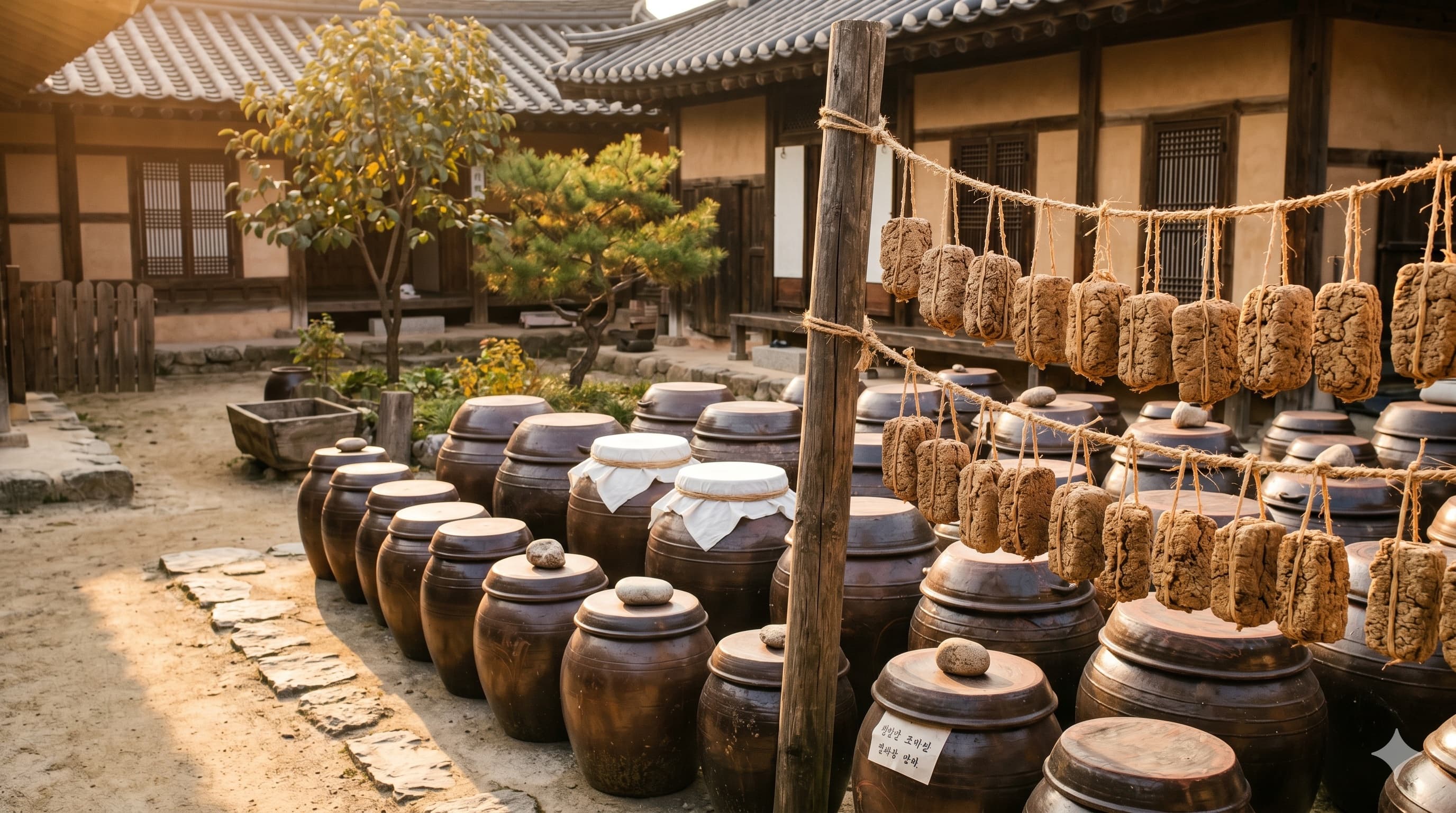
The process starts with meju (메주), blocks of cooked soybeans that are mashed, shaped into bricks, and left to ferment. In traditional Korean practice, soybeans are harvested in autumn, boiled until soft, pounded in a mortar or shaped by hand into rectangular blocks about the size of a brick, then tied with rice straw and hung from the eaves of the house or placed in a warm, well-ventilated room.
Over the next two to three months, a succession of microorganisms colonizes the meju. The first wave is mold — primarily Aspergillus oryzae and related species — which appears as a white, then yellowish-green, fuzzy coating on the surface. These molds produce powerful enzymes (proteases and amylases) that begin breaking down the soybeans' proteins into amino acids and their starches into sugars. This enzymatic activity is the foundation of umami development.
Simultaneously, beneficial bacteria — including Bacillus subtilis, a close relative of the bacteria used to make Japanese natto — penetrate deeper into the meju, producing additional enzymes and contributing to the complex fermentation chemistry. The rice straw itself is a carrier of these desirable microorganisms, which is why traditional meju-making uses straw as both a structural and microbial element.
From Meju to Doenjang and Ganjang
In early spring, the fermented meju blocks are placed into large earthenware crocks called onggi (옹기) with a brine solution made from solar-evaporated sea salt and water. Charcoal and dried chili peppers are often placed in the brine — the charcoal absorbs off-flavors and impurities, while the chili peppers may have mild antimicrobial properties that help steer the fermentation.
The onggi crocks are placed outdoors on a platform called a jangdokdae (장독대), where they are exposed to sunlight, wind, and natural temperature fluctuations. The lids are removed on sunny days to allow UV exposure (which discourages harmful bacteria) and replaced at night or during rain. This daily tending of the jang crocks has been a central domestic ritual in Korean households for centuries.
After two to three months of brining, the liquid is separated from the solids. The liquid becomes ganjang — Korean soy sauce — which is boiled, cooled, and returned to a clean onggi for further aging. The solids are mashed and packed into a separate crock to become doenjang. Both continue to age and develop flavor, with the finest doenjang and ganjang maturing for years or even decades.
Gochujang: The Chili Paste
Gochujang follows a different but related process. Meju powder (or sometimes a fermented rice and soybean mixture) is combined with gochugaru (Korean chili flakes), glutinous rice powder (which provides starch for the molds and bacteria to convert into sugars), salt, and sometimes malt syrup or grain syrup. The mixture is packed into onggi and fermented for several months.
The result is a paste with a uniquely complex flavor profile: sweet from the rice starches, spicy from the chili, savory-umami from the fermented soybeans, and slightly funky from the ongoing microbial activity. No other condiment in the world quite matches gochujang's multidimensional character. It is this complexity that makes gochujang so addictive in dishes like bibimbap, tteokbokki, and countless stews and marinades.
The Role of Onggi
The earthenware onggi vessels are not mere containers — they are active participants in the fermentation process. Onggi is made from a special clay fired at high temperatures, and its walls are micro-porous: they allow air and moisture to pass through while keeping out contaminants. This "breathing" quality creates the semi-aerobic environment that Korean fermentation requires, distinct from the fully anaerobic fermentation used in many Western and Japanese traditions.
The porous walls also help regulate temperature and humidity inside the vessel, buffering against extreme fluctuations. Korean food scientists have studied onggi extensively and found that the microbial communities that develop inside these vessels differ measurably from those in glass or plastic containers, contributing to the distinctive flavor profile of traditionally fermented jang.
Making Jang at Home
While the full traditional jang-making process requires months of patience and outdoor space for onggi crocks, simplified versions are accessible to home cooks. Quick doenjang can be made by fermenting cooked soybeans with salt and a koji (Aspergillus oryzae) starter in a warm spot for four to eight weeks. Several Korean cookbooks and online resources provide detailed instructions for apartment-scale jang-making.
Even if you never make your own jang, understanding the process deepens your appreciation of these ingredients immensely. When you stir a spoonful of doenjang into a simmering pot of vegetables, you are adding not just flavor but the concentrated work of billions of microorganisms and centuries of human knowledge. That is the magic of Korean fermentation.