Tofu Varieties in Japanese Cuisine: From Silken Kinu to Aged Koya-dofu
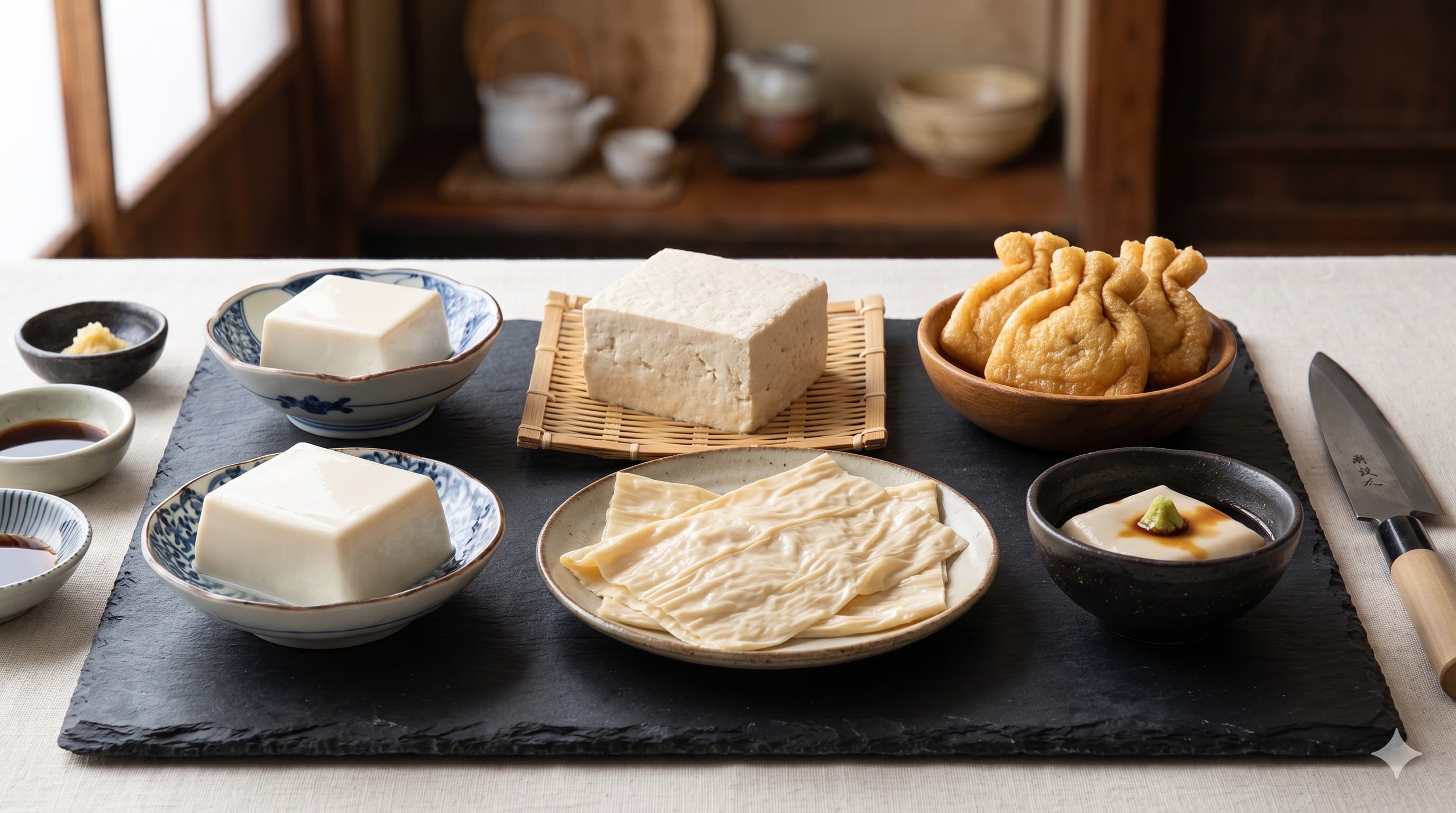
Tofu: Japan's Most Versatile Ingredient
Tofu arrived in Japan from China, most likely during the Nara period (710-794 CE), brought by Buddhist monks and envoys. Over the centuries, Japanese artisans refined tofu-making into a precise craft, developing varieties and preparations far beyond the original Chinese forms. Today, Japanese tofu culture encompasses dozens of distinct products, each with its own texture, flavor, and culinary purpose. For plant-based cooks, understanding these varieties opens up an enormous range of possibilities.
Kinu-dofu (Silken Tofu)
Kinu-dofu, or silken tofu, is made by coagulating soy milk without pressing out the whey. The result is an extraordinarily smooth, custard-like tofu with a high water content and delicate texture. It literally translates to "silk tofu," a name that accurately describes its surface.
Silken tofu is best enjoyed in preparations that showcase its softness. Hiyayakko — chilled silken tofu topped with grated ginger, sliced scallions, and soy sauce — is one of Japan's most beloved summer dishes. It also appears in miso soup, where it floats in soft cubes, and in modern preparations like smoothies and desserts. Silken tofu should not be stir-fried or grilled, as it will break apart.
Momen-dofu (Cotton/Firm Tofu)
Momen-dofu, or cotton tofu, is made by pressing the curds in a cloth-lined mold, which gives it a firmer texture and slightly lower water content than silken tofu. The name comes from the cotton cloth traditionally used to press it, which sometimes leaves a faint crosshatch pattern on the surface.
Momen-dofu is the workhorse of Japanese cooking. It holds up to grilling, frying, simmering, and stir-frying. It is the standard choice for dishes like tofu steak, mapo tofu (adapted from Chinese cuisine), and champuru (the Okinawan stir-fry). Its firmer texture also makes it ideal for crumbling into dishes as a protein-rich substitute for scrambled eggs or ground meat.
Yuba (Soy Milk Skin)
Yuba is the thin film that forms on the surface of heated soy milk, carefully lifted off by hand. Fresh yuba (nama-yuba) has a silky, almost creamy texture and a subtle sweetness that makes it one of the most refined soy products in existence. Dried yuba can be reconstituted and used in soups, stir-fries, and wraps.
Yuba is a specialty of Kyoto and Nikko, where shops have produced it for centuries. In shojin ryori, yuba is often served as a form of sashimi — sliced, arranged on a plate, and dipped in soy sauce with wasabi, just as one would eat raw fish. It is also wrapped around vegetables and simmered in dashi, or deep-fried for a crispy texture.
Koya-dofu (Freeze-Dried Tofu)
Koya-dofu, also called kori-dofu or shimi-dofu, is tofu that has been frozen, thawed, and dried. This process, traditionally accomplished by leaving tofu outdoors during winter at high-altitude locations like Mount Koya, transforms the texture completely. When reconstituted in broth, koya-dofu becomes sponge-like, absorbing flavors intensely while providing a satisfyingly chewy texture.
Named after Mount Koya (Koyasan), the headquarters of Shingon Buddhism in Wakayama Prefecture, koya-dofu has been produced since at least the sixteenth century. It is a pantry staple with a long shelf life, making it practical for mountain monasteries. It is typically simmered in sweetened dashi and served as part of a traditional Japanese meal.
Abura-age and Atsu-age (Fried Tofu)
Abura-age is tofu that has been sliced thin and deep-fried twice — first at a low temperature to puff up the interior, then at a higher temperature to crisp the outside. The result is a golden pouch that can be stuffed with sushi rice (inari-zushi), sliced into strips for udon toppings, or simmered in sweetened broth. Atsu-age is a thicker cut of tofu that is deep-fried to create a crispy exterior while maintaining a soft interior. It is commonly added to stews and stir-fries.
Goma-dofu (Sesame Tofu)
Technically not a soy product at all, goma-dofu is made from ground sesame paste and kuzu (Japanese arrowroot starch), cooked until thick and set into a block. It has a smooth, almost pudding-like texture and a rich, nutty flavor. Goma-dofu is a signature dish of shojin ryori, particularly associated with the temple cuisine of Koyasan. It is typically served chilled with a dab of wasabi and a drizzle of soy sauce.
Choosing and Using Japanese Tofu
The key to cooking well with tofu is matching the variety to the preparation. Use silken tofu for cold dishes, soups, and desserts. Use firm momen tofu for grilling, frying, and stir-frying. Use koya-dofu for simmered dishes where you want maximum flavor absorption. Use yuba when you want elegance and subtlety. And remember that fresh, high-quality tofu — made with just soybeans, water, and a coagulant like nigari (magnesium chloride) — tastes vastly better than mass-produced versions. If you can find a local tofu maker, the difference is transformative.