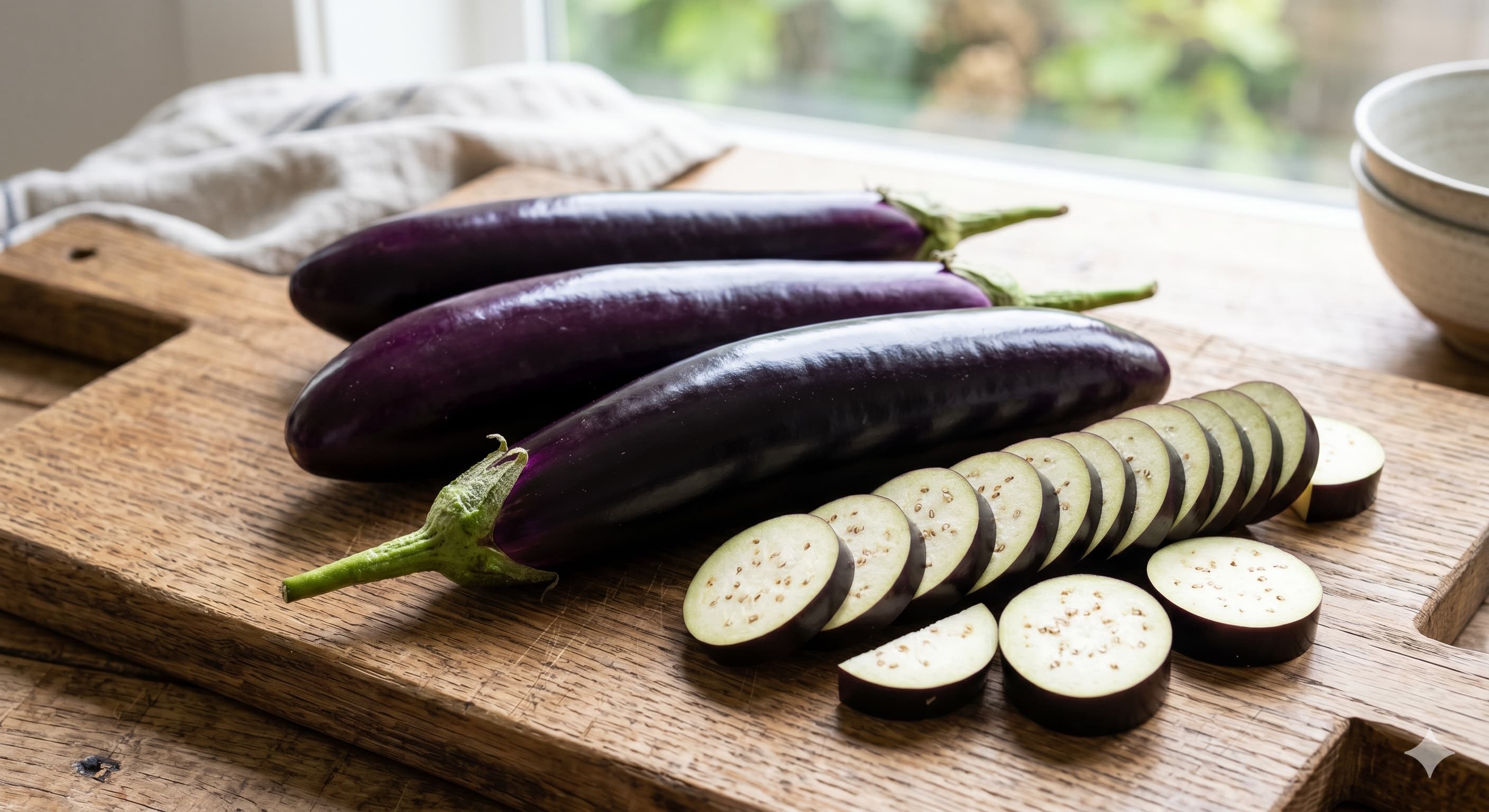
Eggplant
Solanum melongena
Eggplant originated in India and traveled to Korea via China, where it has been cultivated for well over a thousand years. The Korean name 가지 (gaji) is derived from the Sino-Korean 가자 (茄子), and Koreans developed a unique culinary relationship with this vegetable quite different from Mediterranean traditions. While Western cuisines tend to roast, grill, or fry eggplant with oil, Korean — and especially Korean temple — cuisine discovered that simple steaming reveals eggplant's most ethereal quality: a melt-on-the-tongue silkiness that needs only a touch of perilla oil and soy sauce. This temple-style preparation (사찰식 가지나물) is a masterclass in Korean Buddhist cooking philosophy: using minimal intervention to reveal an ingredient's true nature. Korean eggplants are distinctly slender and long, with thin, tender purple skin that never needs peeling. The Donguibogam classifies eggplant as cooling, making it a favored summer vegetable believed to clear excess body heat during Korea's notoriously humid, sweltering July and August.
New to Eggplant?
Is this edible?
Yes! Korean eggplant is a summer staple eaten steamed, stir-fried, and pan-fried across the country. It is slender and tender with thin, edible skin — much more delicate than the large globe eggplant familiar in Western cooking.
What does it taste like?
Similar to Japanese eggplant — milder, sweeter, and less bitter than globe eggplant. When steamed, it becomes meltingly silky, almost custard-like in texture.
Where to buy
Korean or Japanese eggplant at Asian grocery stores (H Mart, Lotte, Uwajimaya). Chinese eggplant at any Asian grocery works too. In summer, farmers markets often carry similar slender varieties. Italian Fairy Tale or Graffiti eggplants are good substitutes.
How to prepare
No need to peel — the thin skin is tender and edible. Simply trim the stem end, slice or halve lengthwise, and steam for 5-7 minutes until soft. Tear into strips by hand for the most authentic namul texture.
Pro tip: Tearing by hand instead of cutting with a knife gives the eggplant rough edges that grab and hold the seasoning sauce much better.
Traditional Medicine
Source: Donguibogam (동의보감)
Nature (性)
Cool (涼)Flavor (味)
sweet
Target Organs (歸經)
Spleen (脾), Heart (心), Lung (肺)
Benefits
- circulation
Activates blood flow and resolves blood stasis, promoting healthy circulation
혈맥을 활발하게 하고 어혈을 풀어준다
Source: 동의보감 [탕액편] 채부
- anti inflammation
Clears heat-toxins and reduces swelling, making it useful for inflammatory conditions during hot weather
열독을 내리고 부기를 가라앉힌다
Source: 동의보감 [탕액편] 채부
- detox
Cools heat in all five organs and dispels pathogenic wind
오장의 열을 내리고 풍을 제거한다
Source: 동의보감 [탕액편] 채부
Key Compounds
This information is based on traditional Korean medicine texts (Donguibogam) and is for cultural reference only. It does not constitute medical advice.
Seasonal Availability
Korean eggplant season runs from July through September. Summer eggplant has thin, tender skin and fewer seeds, making it ideal for steaming. Korean eggplants are slender and long (similar to Japanese varieties), with a more delicate flavor than the large globe eggplants common in Western markets.
Complementary Ingredients (궁합 재료)
The quintessential temple food pairing — warming perilla oil balances eggplant's strong cooling nature while adding an earthy, nutty depth that elevates the vegetable
Source: Korean temple food tradition
The heat and spice of gochugaru cuts through the eggplant's mild sweetness, creating a lively stir-fry or muchim
A sprinkle of toasted sesame adds crunch and nuttiness to the soft, silky texture of steamed eggplant
Processing Methods (법제)
Steaming preserves the cool, healing nature of eggplant and keeps it melt-in-your-mouth tender. This is the preferred temple food preparation.
Lightly salting cut eggplant draws out bitter juices and excess moisture, improving both flavor and texture before cooking.
Consumption Tips by Health Goal
Circulation
Eat steamed eggplant regularly during summer months. The cooling nature helps counteract summer heat while the flesh promotes blood flow.
Anti-inflammation
Consume with the purple skin intact — the skin contains the highest concentration of nasunin, a powerful antioxidant anthocyanin. Steaming is the best method to preserve these compounds.
Detox
Pair with warming perilla oil to balance eggplant's strong cooling nature. This combination is traditional in temple food and prevents overcooling the digestive system.
Culinary Profile
Flavor
Delicate, mildly sweet with a subtle earthy quality; Korean eggplant is less bitter than Western globe varieties and has a more refined, gentle flavor that lends itself to simple preparations
Texture
Silky, melt-in-your-mouth when steamed; creamy and custard-like when roasted; slightly spongy when raw, it eagerly absorbs sauces and oils
Common Uses
Western Substitutes
Related Recipes
Pan-fried Tofu and Eggplant with Soy Sauce
근사한 두부가지구이
Easy | 40 min
Herb-infused Eggplant Stir-fry
허브 가지볶음
Easy | 20 min
Soy-Braised Stir-Fried Eggplant
가지볶음
Easy | 15 min
Grilled Eggplant with Soy Dressing
가지구이
Easy | 15 min
Oat-Mushroom Patty Sandwich
귀리버섯패티 샌드위치
Easy | 40 min
Air-Fryer Roasted Mushrooms and Vegetables
에어프라이어 버섯 채소구이
Easy | 26 min
Roasted Eggplant Gambas
가지감바스
Easy | 20 min
Eggplant and Pepper Miso Stir-Fry (Nabeshigi)
가지 피망 된장볶음
Easy | 20 min
Temple-Style Ratatouille
정진 라타투이
Hard | 0 min
Quick-Pickled Eggplant
가지 아사즈케
Hard | 0 min
Shibazuke (Kyoto Purple Eggplant Pickle)
시바즈케 (교토 자색 채소절임)
Medium | 20 min
Nukazuke (Japanese Rice Bran Fermented Pickles)
누카즈케 (쌀겨 발효절임)
Hard | 30 min
Eggplant Tangsuyuk with Rice Paper
가지 탕수육
Medium | 80 min
Miso Dengaku (Miso-Glazed Tofu and Vegetable Skewers)
미소 뎅가쿠 (된장 꼬치구이)
Easy | 30 min
Nasu Dengaku (Miso-Glazed Eggplant)
나스 뎅가쿠 (가지 된장구이)
Easy | 25 min
Eggplant Doenjang Rice Bowl
가지 된장 덮밥
Easy | 15 min
Vegetable Bibimbap with Young Radish Kimchi
채소 열무 비빔밥
Easy | 40 min
Eggplant-wrapped Rice Balls with Tofu Filling
가지 주먹밥 두부 속
Easy | 26 min
Eggplant Rice Bowl
가지덮밥
Easy | 26 min
Aged Rice Bran Pickle Tea Rice (Ochazuke)
쌀겨절임 오차즈케
Easy | 10 min
Eggplant and Burdock Root Miso Soup
가지 우엉 된장국
Easy | 15 min
Eggplant & Mint (Banga) Jeon
방아 가지전
Easy | 40 min
Fried Eggplant with Plum Sauce
가지 튀김 매실 소스
Medium | 0 min
Temple-Style Fried Eggplant with Sweet Miso
가지 정진 프라이 단된장 소스
Hard | 0 min
Fried Eggplant and Okra with Grated Radish
가지 오크라 튀김 무즙 무침
Hard | 0 min
Shojin Age (Temple-Style Vegetable Tempura)
정진아게 (사찰 채소 튀김)
Medium | 35 min
Nasu no Agebitashi (Deep-Fried Eggplant in Dashi)
나수노 아게비타시 (가지 튀김 절임)
Medium | 20 min
Five-Color Noodles
오색 소면
Hard | 0 min
Falafel Pasta
팔라펠 파스타
Medium | 40 min
Soy Milk Cream Pasta with Eggplant
두유 크림 가지 파스타
Easy | 40 min
Temple-style Steamed Eggplant
사찰식 가지나물
Easy | 15 min
Spicy Steamed Eggplant Namul
가지나물무침
Easy | 40 min
Stir-fried Eggplant with Perilla Oil
가지볶음나물
Easy | 40 min
Grilled Eggplant Muchim
구워서 만든 가지무침
Easy | 20 min
Grilled Ginseng & Vegetable Salad
인삼 샐러드
Medium | 40 min
Grilled Eggplant Salad
구운 가지 무침
Easy | 20 min
Grilled Eggplant Roll Salad with Balsamic
가지샐러드
Easy | 15 min