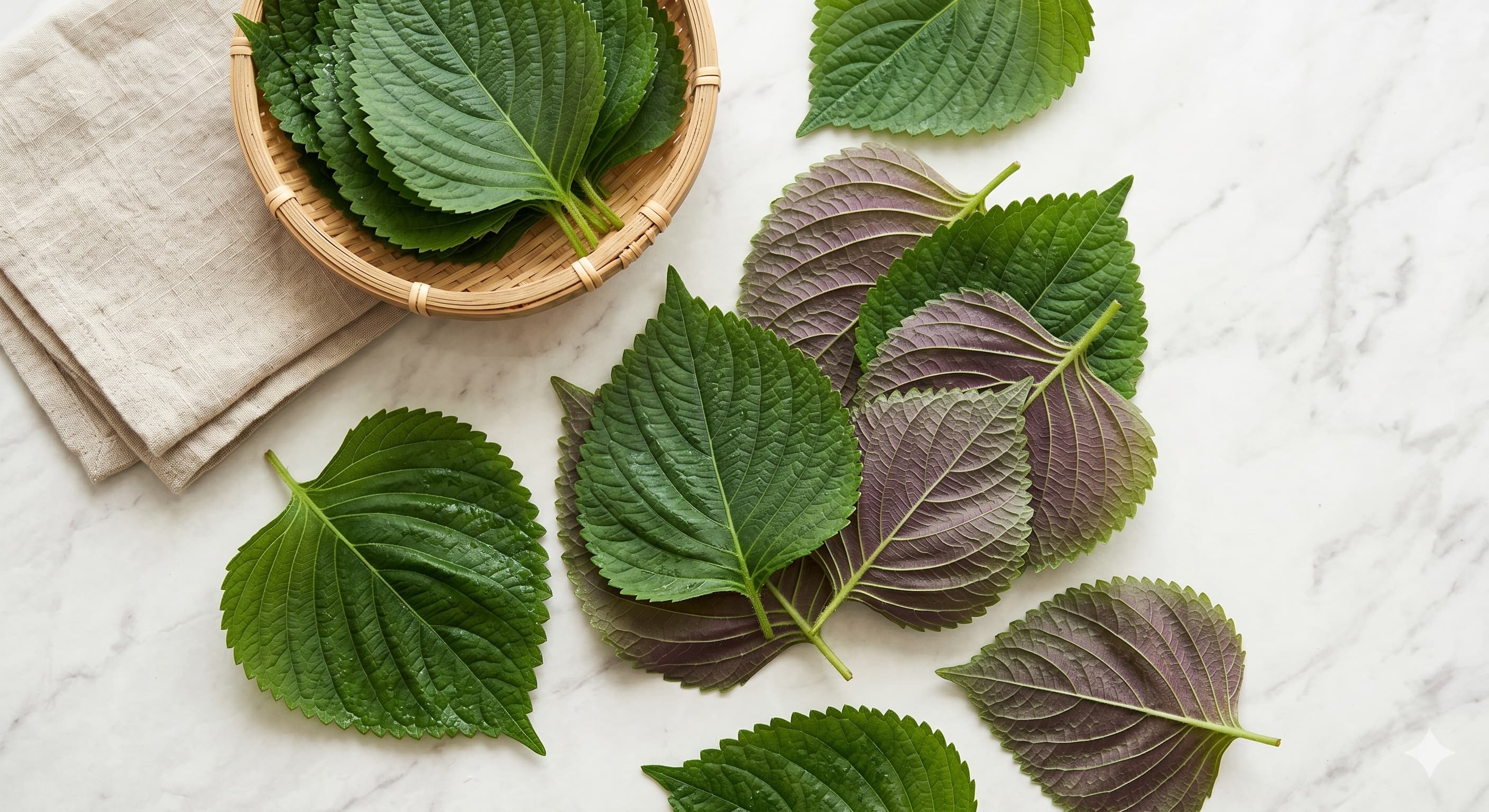
Perilla Leaves
Perilla frutescens
Perilla leaves (kkaennip) are one of the most distinctive and ubiquitous herbs in Korean cuisine, with a bold, complex flavor that has no exact equivalent in Western cooking. The Donguibogam classifies perilla leaf (紫蘇葉/자소엽) as warm in nature and pungent in flavor, noting it disperses cold, promotes qi circulation, and harmonizes the stomach. Kkaennip belongs to the same plant family as basil and mint but tastes like neither — its unique herbaceous, slightly anise-like flavor with minty undertones is immediately recognizable. In Korea, kkaennip is eaten fresh as a ssam (wrap) leaf, pickled in soy sauce (kkaennip-jangajji), and used as a garnish throughout the cuisine. Korean grocery stores stock it year-round, and many Korean families grow it in their gardens or even on apartment balconies.
New to Perilla Leaves?
Is this edible?
Yes! Perilla leaves are one of the most commonly eaten herbs in Korea, consumed daily as a wrap for rice, pickled in soy sauce, or used as a garnish. They are perfectly safe and widely available in Korean communities.
What does it taste like?
Unlike anything in Western cuisine — imagine a blend of basil, mint, and anise with a grassy, slightly earthy quality all its own. Bold and aromatic but not overwhelming. Nothing else tastes quite like it.
Where to buy
Korean grocery stores (H Mart, Lotte) always have them in the fresh herb/produce section, usually in bundles of 30-50 leaves. Some Japanese stores sell the smaller Japanese shiso variety. Not found in regular Western supermarkets.
How to prepare
Wash individual leaves and pat dry. For ssam (wraps): use raw, placing a leaf in your palm, adding rice and toppings, and folding. For kkaennip-jangajji (pickled): stack leaves, pour seasoned soy sauce over them, and refrigerate.
Pro tip: Kkaennip makes an incredible quick ssam (wrap) even with non-Korean foods — try wrapping a bite of anything savory in a perilla leaf with a dab of ssamjang. It transforms any meal into something special.
Traditional Medicine
Source: Donguibogam
Nature (性)
Warm (溫)Flavor (味)
pungent
Target Organs (歸經)
Lung (肺), Spleen (脾)
Benefits
- digestion
Descends qi and dissolves phlegm
기를 내리고 담을 삭인다
Source: Donguibogam
- detox
Neutralizes fish and shellfish toxins
어독과 게독을 풀어준다
Source: Donguibogam
Key Compounds
This information is based on traditional Korean medicine texts (Donguibogam) and is for cultural reference only. It does not constitute medical advice.
Seasonal Availability
Peak flavor in summer months. Greenhouse-grown available year-round but less aromatic.
Culinary Profile
Flavor
Intensely aromatic, minty-basil-like, slightly anise
Texture
Thin, slightly fuzzy, tender
Common Uses
Western Substitutes
Related Recipes
Spicy Bibim Dumplings
정말 쉬운 비빔만두
Easy | 20 min
Addictive Marinated Summer Vegetables
여름야채 절임
Medium | 20 min
Chilled Tofu with Eggplant Miso Sauce
가지 된장소스 냉두부
Easy | 5 min
Quick Salt-Pickled Cucumber
오이 아사즈케
Easy | 10 min
Perilla Leaf Kimchi
깻잎 양념장 절임
Easy | 20 min
Herb Garden Bibimbap
허브비빔밥
Easy | 40 min
Colorful Sushi
알록달록 꽃김밥
Medium | 80 min
Crispy Chive Jeon
부추전
Easy | 15 min
Gochujang Jangddeok
고추장 장떡
Easy | 26 min
Jaengban Makguksu (Sharing Platter Cold Noodles)
쟁반막국수
Medium | 35 min
Temple-Style Plum and Myoga Pasta
매실 양하 정진 파스타
Hard | 0 min
Five-Color Noodles
오색 소면
Hard | 0 min
Perilla Leaf Shoots Namul with Ground Perilla Seeds
깻잎순 들깨볶음
Easy | 20 min
Stir-fried Perilla Leaf Shoots Namul
깻잎순나물볶음
Easy | 20 min
Stir-fried Young Perilla Shoots
깻잎순 올리브유볶음
Easy | 40 min
Perilla Leaf and Tofu Salad
깻잎 두부 무침
Easy | 15 min
Perilla Seed Chive Salad
들깨부추샐러드
Easy | 15 min
Cucumber and Citrus Sesame Vinegar Salad
오이 감귤 참깨초 무침
Easy | 0 min