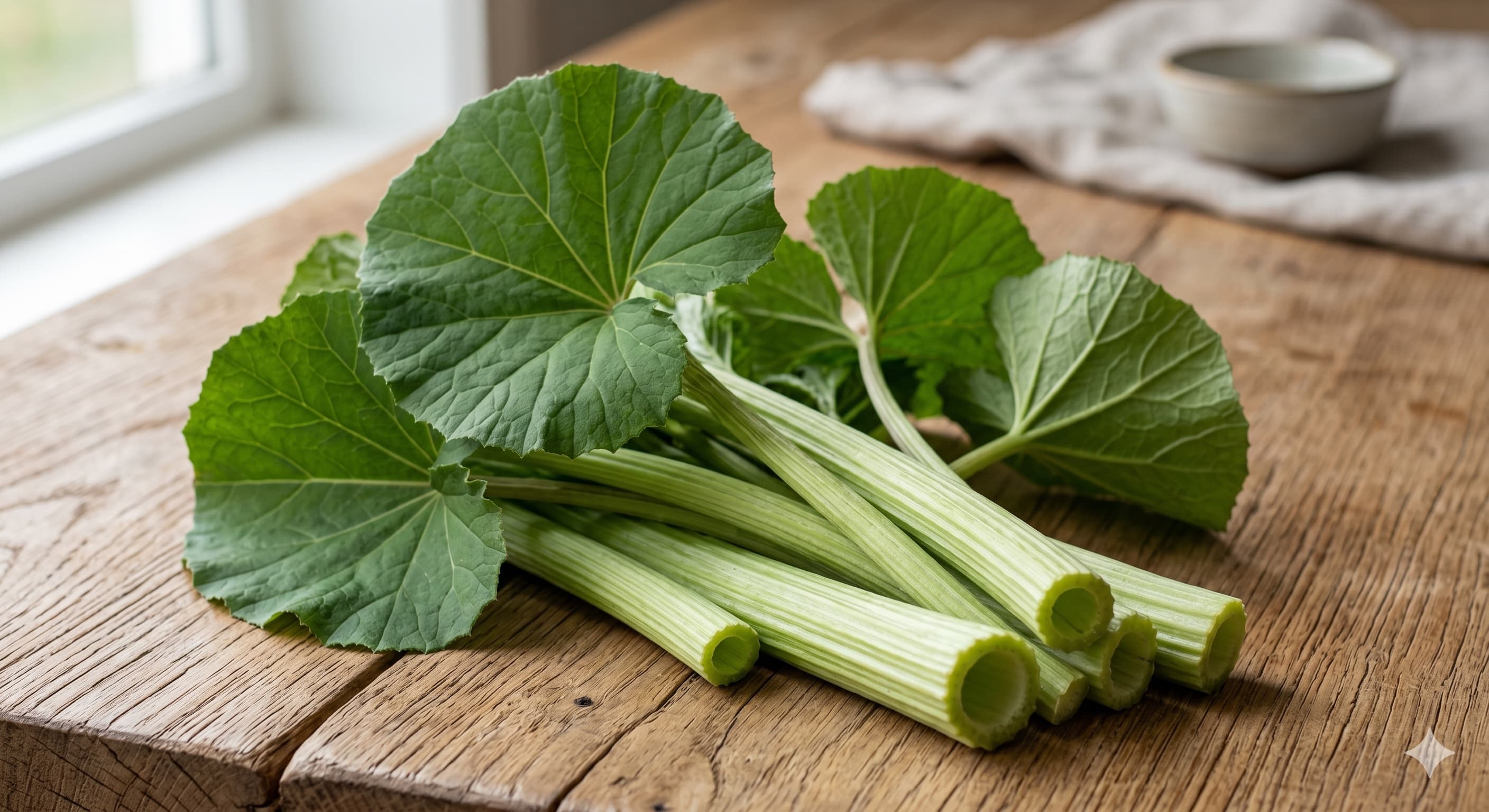
Butterbur (Meowi)
Petasites japonicus (Siebold & Zucc.) Maxim.
Butterbur (머위) is one of Korea's most ancient wild greens, growing along stream banks and shady hillsides across the peninsula. Its large, round leaves — sometimes spanning a foot across — make it unmistakable in the spring woods. The Donguibogam records the flower buds (款冬花, gwandongwha) as a key medicine for cough and lung ailments, noting that the plant blooms so early it seems to 'welcome winter.' In Korean mountain temple cooking, butterbur is especially valued as one of the first fresh greens after the long winter of preserved and dried foods. Buddhist monks would gather the young leaves in early spring, blanch them to tame the bitterness, and dress them simply with perilla oil and doenjang. The stems (머위대, meowi-dae) are treated as a separate ingredient entirely — peeled, braised, and stir-fried into deeply savory side dishes. The mandatory blanching step is not just for flavor — it removes naturally occurring pyrrolizidine alkaloids, a practice Korean grandmothers have known intuitively for centuries.
New to Butterbur (Meowi)?
Is this edible?
Yes, but MUST be blanched first. Raw butterbur contains compounds that should not be consumed without cooking. Always boil and soak before eating.
What does it taste like?
Pleasantly bitter and herbal after proper blanching — like a cross between artichoke and dandelion greens. The stems taste milder and more vegetal than the leaves.
Where to buy
Korean grocery stores in spring (March-May). Japanese grocery stores sell it as 'fuki.' Dried butterbur stems are available year-round at Korean markets.
How to prepare
Blanch leaves in boiling salted water for 2-3 minutes, then soak in cold water for at least 30 minutes (longer reduces bitterness more). For stems, peel the tough outer skin, blanch, and soak.
Pro tip: Start with butterbur stems (meowi-dae) rather than leaves — they are milder and easier to enjoy for first-timers. Stir-fry with a little soy sauce and perilla oil for a simple introduction.
Traditional Medicine
Source: Donguibogam (동의보감)
Nature (性)
Warm (溫)Flavor (味)
bitter
Target Organs (歸經)
Lung (肺)
Benefits
- lung health
Relieves cough, expels phlegm, and directs lung qi downward
기침을 멎게 하고 담을 삭이며 폐의 기운을 내린다
Source: 동의보감 [탕액편] 초부 관동화조
- respiratory
Effective for chronic cough and asthma symptoms
오래된 기침과 천식에 효과가 있다
Source: 동의보감 [탕액편] 초부 관동화조
Key Compounds
This information is based on traditional Korean medicine texts (Donguibogam) and is for cultural reference only. It does not constitute medical advice.
Seasonal Availability
Butterbur is a spring vegetable, best from March to May. The young leaves and stems emerge as one of the earliest wild greens of the year. The stems (meowi-dae) are sometimes available dried year-round.
Complementary Ingredients (궁합 재료)
Processing Methods (법제)
Removes pyrrolizidine alkaloids and reduces the strong bitter taste to a pleasant herbal flavor
Consumption Tips by Health Goal
lung_health
Consume blanched butterbur namul in spring to support lung function and clear accumulated winter phlegm
Culinary Profile
Flavor
Distinctly bitter and herbal when raw, mellowing to a complex, earthy-green flavor after blanching. The bitterness is part of its appeal — Koreans prize this as a cleansing spring taste
Texture
Large, round leaves are tender after blanching. The thick stems (meowi-dae) have a satisfying, slightly fibrous crunch similar to celery
Common Uses
Western Substitutes