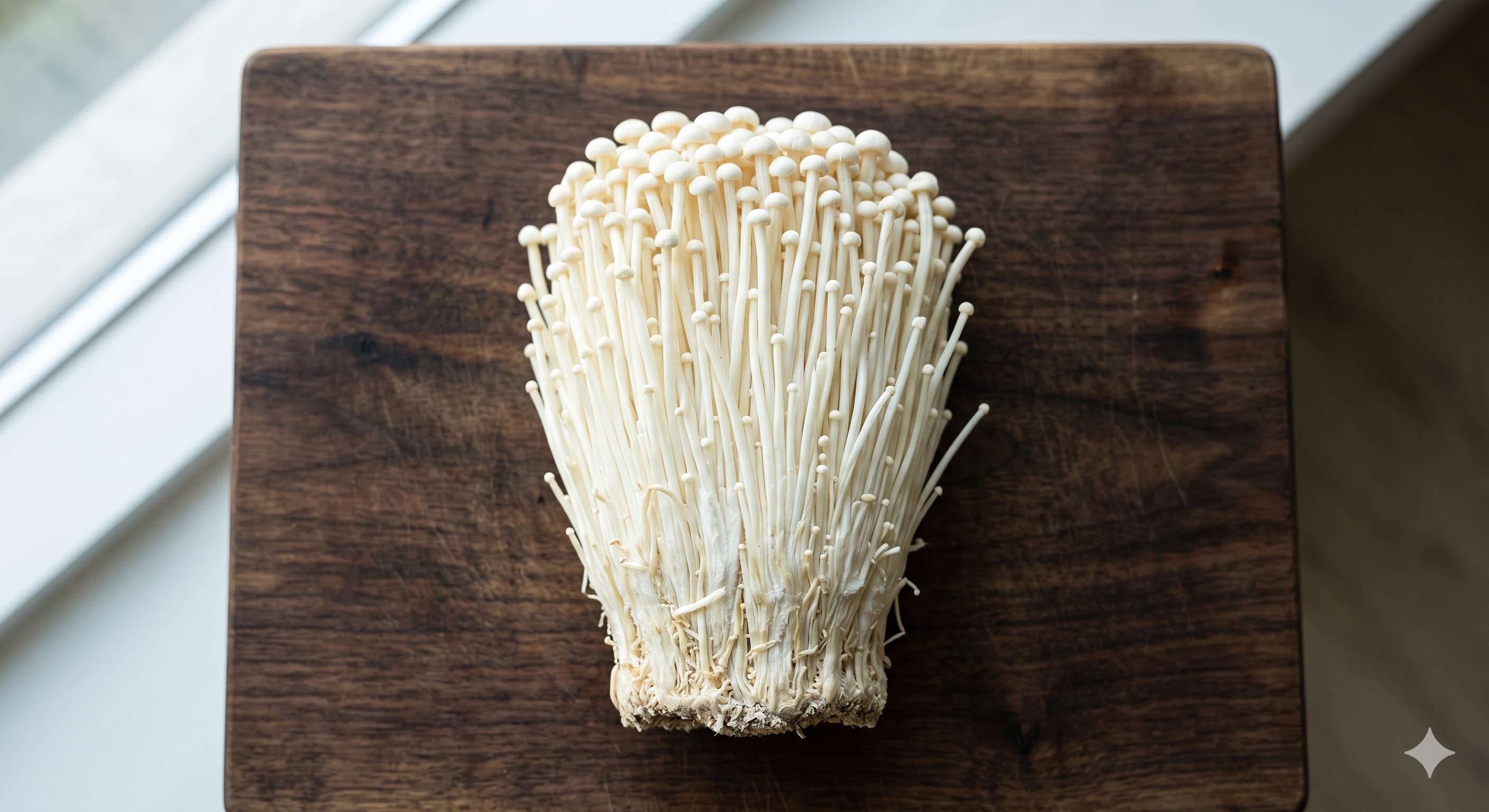
Enoki Mushroom
Flammulina velutipes
Enoki mushrooms have been cultivated in East Asia for centuries, though modern cultivation produces the familiar long, white strands quite different from the wild form. While not individually named in the Donguibogam, enoki mushrooms share the general qi-tonifying and immunity-boosting properties attributed to edible fungi in Korean medicine. Their delicate, slightly crunchy texture makes them a popular last-minute addition to Korean soups and stews, where they contribute a gentle sweetness and visual elegance.
New to Enoki Mushroom?
Is this edible?
Yes! Enoki mushrooms are a beloved ingredient in Korean cooking, appearing in soups, hot pots, stir-fries, and as a filling for jeon (pancakes). Their delicate, noodle-like appearance makes them uniquely versatile.
What does it taste like?
Very mild, clean, and slightly sweet with a delicate, almost fruity quality. The texture is the main attraction — thin, crunchy stems with tiny caps that have a satisfying snap when you bite through them.
Where to buy
Korean and Asian grocery stores (H Mart, 99 Ranch) always stock them. Increasingly available at regular supermarkets in the specialty mushroom section. They come in vacuum-sealed packages and should be white and firm, not slimy or brown.
How to prepare
Cut off the spongy root cluster at the base (about 2-3cm from the bottom). Separate the individual strands gently. Rinse briefly if needed. They cook in just 1-2 minutes.
Pro tip: Enoki cook extremely fast — add them at the very last moment to soups and stir-fries. Overcooking turns them limp and slimy. For an addictive snack, pan-fry small bundles with a light coating of batter until crispy (paengi-beoseot-jeon).
Traditional Medicine
Source: Donguibogam (동의보감)
Nature (性)
Cool (涼)Flavor (味)
sweet
Target Organs (歸經)
Spleen (脾), stomach, Liver (肝)
Benefits
- immunity
Tonifies vital essence and repels pathogens
정기를 보하고 사기를 물리친다
Source: 동의보감 [탕액편] 채부 — general mushroom properties
Key Compounds
This information is based on traditional Korean medicine texts (Donguibogam) and is for cultural reference only. It does not constitute medical advice.
Seasonal Availability
Cultivated year-round in dark, cool facilities. The long, thin white cultivated form differs dramatically from the short, brown wild form.
Processing Methods (법제)
Cut off the compacted base, then gently separate the individual strands for even cooking.
Consumption Tips by Health Goal
Immunity
Add to soups and hot pots in the last few minutes of cooking. Brief cooking preserves the delicate texture while releasing beneficial compounds.
Culinary Profile
Flavor
Mild, slightly fruity and sweet; very delicate flavor; provides textural interest rather than strong taste
Texture
Thin, delicate strands with a slight crunch that becomes silky in hot broth
Common Uses
Western Substitutes
Related Recipes
Stuffed Tofu Sobagi
소박이 두부
Easy | 40 min
Crispy Enoki Mushroom Floss
팽이자반
Easy | 15 min
Spicy Grilled Enoki Mushrooms
팽이버섯매콤구이
Easy | 10 min
Easy Microwave Mushroom Marinade
버섯 마리네
Easy | 10 min
Addictive Marinated Summer Vegetables
여름야채 절임
Medium | 20 min
Carrot and Enoki Miso Kinpira
당근 팽이버섯 된장 볶음
Medium | 0 min
Rapeseed and Enoki Nori Roll Tempura
유채꽃 팽이버섯 김말이 튀김
Medium | 0 min
Shiitake Mushroom Sushi
표고버섯 초밥
Easy | 80 min
Bell Pepper and Enoki Mushroom Rice Bowl
식단 파프리카 팽이버섯덮밥
Easy | 15 min
Mixed Mushroom Fried Rice
버섯볶음밥
Easy | 40 min
Mushroom Hot Pot
버섯전골
Medium | 45 min
Green Seaweed (Aosa) Miso Soup
아오사 된장국
Easy | 10 min
Sweet Cabbage Miso Soup
양배추 된장국
Easy | 20 min
Molokhia and Tofu Miso Soup
모로헤이야 두부 된장국
Easy | 10 min
Doenjang Jjigae with Gochujang
된장찌개
Easy | 40 min
Spicy Braised Enoki Mushrooms
오독오독 매운팽이버섯
Easy | 15 min
Spicy Bibim Glass Noodles
비빔당면
Easy | 80 min
Enoki Mushroom Mustard Salad
팽이버섯 겨자무침
Easy | 20 min