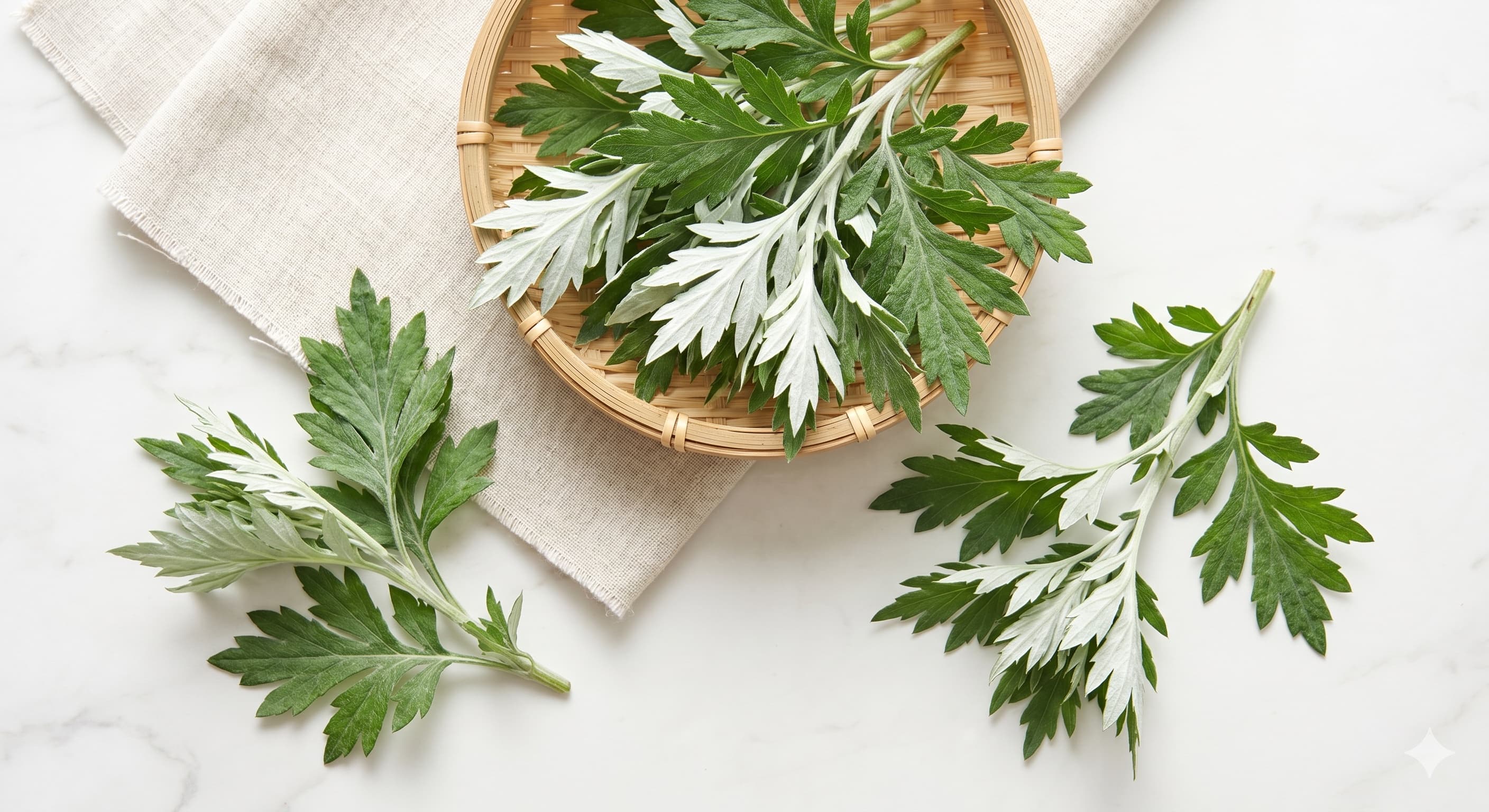
Mugwort
Artemisia princeps
Mugwort (ssuk) is perhaps the most culturally significant herb in all of Korean tradition, appearing in the nation's founding myth itself — the Dangun creation story tells of a bear who ate only garlic and mugwort for 100 days in a cave to become human and eventually gave birth to Dangun, the legendary founder of Korea. The Donguibogam classifies mugwort (艾/애) as warm in nature and bitter in flavor, noting it warms the meridians, stops bleeding, and disperses cold. In Korean medicine, dried mugwort is the primary material for moxibustion (뜸), a healing practice that has been used for thousands of years. In cuisine, ssuk appears in spring rice cakes (ssuk-tteok/ssuk-gae-tteok), soups, and porridges, its distinctive herbal bitterness prized as a spring tonic that clears the body of accumulated winter stagnation.
New to Mugwort?
Is this edible?
Yes! Mugwort has been eaten in Korea since the nation's mythological founding — it literally appears in Korea's origin story. It is widely used in rice cakes, soups, and teas, and is completely safe in normal culinary quantities.
What does it taste like?
Distinctly herbal and slightly bitter, like a more intense version of sage or chrysanthemum greens. In rice cakes (ssuk-tteok), the bitterness mellows into a pleasant, aromatic earthiness.
Where to buy
Korean grocery stores (H Mart) sell fresh ssuk in spring or frozen ssuk year-round. Dried mugwort is available in the dried herb section or online. Japanese grocery stores sell it as 'yomogi.' Not found in regular Western supermarkets.
How to prepare
Fresh ssuk: pick tender leaves and tips only (avoid woody stems). Blanch in boiling water for 1-2 minutes to reduce bitterness, then squeeze out water. For rice cakes, blend blanched ssuk into the rice cake dough.
Pro tip: A little goes a long way — mugwort's flavor is strong. Start with less than you think you need. Frozen ssuk (pre-blanched) is the easiest option for beginners and works perfectly in rice cakes and porridges.
Traditional Medicine
Source: Donguibogam
Nature (性)
Warm (溫)Flavor (味)
bitter, pungent
Target Organs (歸經)
Spleen (脾), Liver (肝), Kidney (腎)
Benefits
- circulation
Warms the meridians and dispels cold
경맥을 따뜻하게 하고 냉증을 다스린다
Source: Donguibogam
- immunity
Addresses chronic conditions and strengthens constitution
오래된 질병을 다스린다
Source: Donguibogam
Key Compounds
This information is based on traditional Korean medicine texts (Donguibogam) and is for cultural reference only. It does not constitute medical advice.
Seasonal Availability
Young shoots harvested in spring are most tender; older plants become too bitter.
Culinary Profile
Flavor
Distinctly aromatic, slightly bitter, herbaceous
Texture
Soft and slightly fuzzy when fresh
Common Uses
Western Substitutes
Related Recipes
Blanched Horsetail Shoots in Light Soy Dressing
쓰쿠시 오히타시
Easy | 10 min
Songpyeon (Half-Moon Rice Cakes)
송편
Medium | 80 min
Ssuktteok (Mugwort Rice Cake)
쑥떡
Medium | 65 min
Mujigaetteok (Rainbow Rice Cake)
무지개떡
Hard | 95 min
Kusa Mochi (Mugwort Green Rice Cake)
쿠사 모찌 (쑥 찹쌀떡)
Medium | 40 min
Mugwort Sujebi Hot Pot
쑥수제비 전골
Easy | 40 min
Crown Daisy (Ssukgat) Namul with Doenjang
쑥갓무침
Easy | 40 min
Crown Daisy & Tofu Salad
쑥갓두부무침
Easy | 40 min
Wild Aster Gochujang Muchim
쑥부쟁이나물 고추장무침
Easy | 20 min
Shungiku no Gomaae (Chrysanthemum Greens with Sesame)
슌기쿠 고마에 (쑥갓 참깨무침)
Easy | 8 min
Mountain Burdock with Sake Lees
산우엉 주박 무침
Easy | 0 min
Sweet Potato, Apple, and Crown Daisy Sesame Vinegar Salad
고구마 사과 쑥갓 참깨초 무침
Easy | 0 min