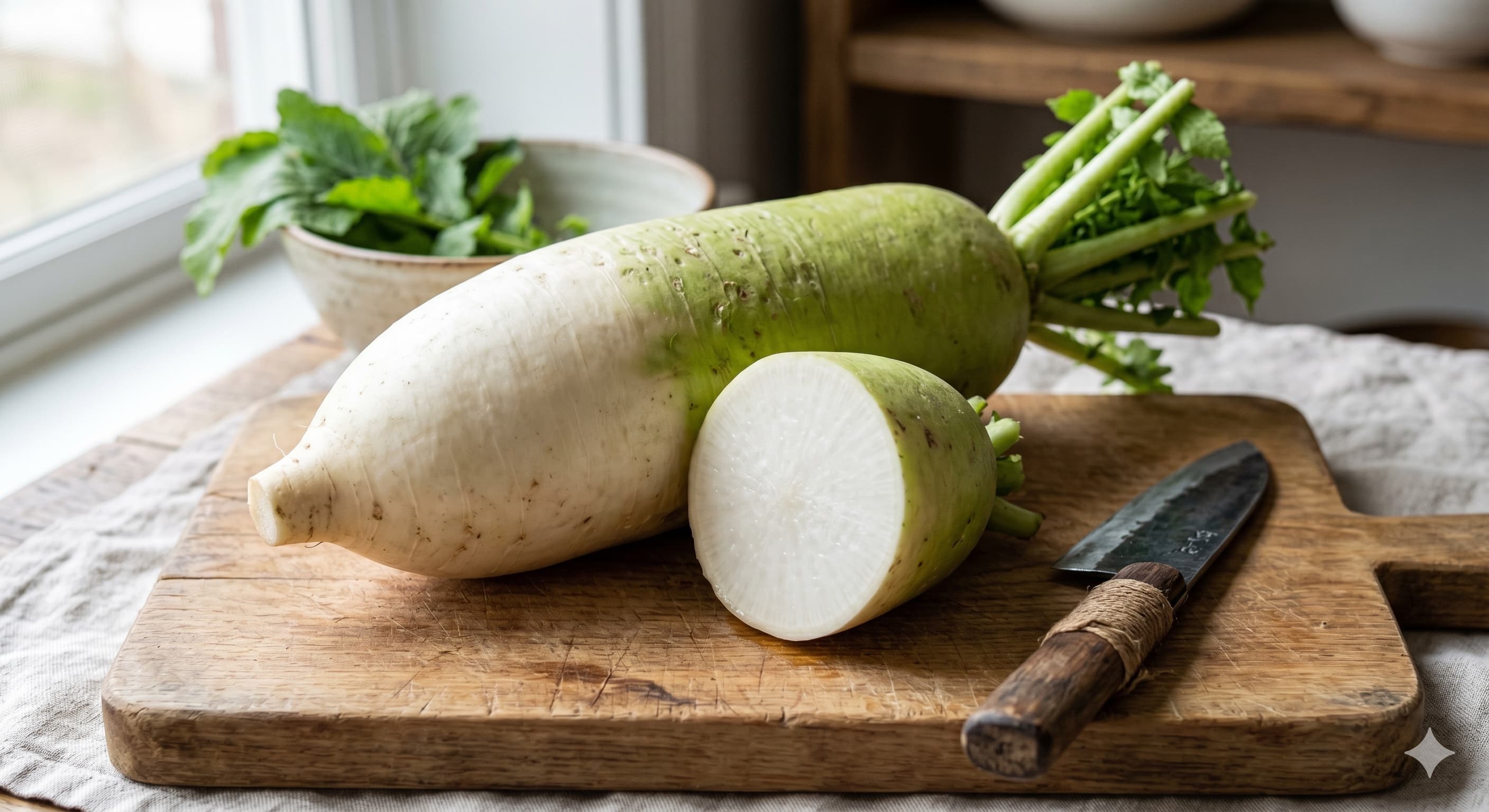
Korean Radish
Raphanus sativus
The Korean radish is so fundamental to Korean cuisine that the single syllable 무 (mu) — one of the shortest words in the Korean language — needs no further explanation. Every Korean knows exactly what you mean. Larger, denser, and sweeter than its Japanese cousin daikon, the Korean mu is arguably the second most important vegetable in Korean cuisine after napa cabbage. Its most critical role comes every November during 김장 (gimjang), the annual communal kimchi-making event now recognized by UNESCO as an Intangible Cultural Heritage of Humanity. During gimjang, mountains of radish are diced into kkakdugi, shredded for kimchi filling, and sliced for dongchimi (water kimchi). The Donguibogam praises radish's digestive powers above almost all other vegetables, and there is a beloved Korean proverb: '무가 약이다' — 'Radish is medicine.' Korean folk medicine uses radish in dozens of home remedies: radish honey syrup for coughs, raw radish juice for hangovers, radish broth for fevers. The vegetable's versatility is staggering — it appears in virtually every meal in some form, whether as crisp raw salad, fermented kimchi, slow-simmered soup, or crunchy pickles.
New to Korean Radish?
Is this edible?
Yes! Korean radish is one of the two most essential vegetables in Korean cuisine (alongside napa cabbage). It appears in some form at virtually every Korean meal — as soup, kimchi, pickles, or salad.
What does it taste like?
Similar to daikon but denser and sweeter, with a mild peppery bite when raw that disappears completely when cooked, turning meltingly sweet and almost translucent.
Where to buy
Korean grocery stores (H Mart, Lotte) always carry it. Look for a large, heavy, pale green-topped white root. Japanese daikon (any Asian grocery or increasingly at regular supermarkets) is the closest substitute.
How to prepare
Peel with a vegetable peeler. For soup, cut into thick chunks. For salad (musaengchae), julienne into thin matchsticks. For kimchi (kkakdugi), dice into 2cm cubes.
Pro tip: The top third near the greens is sweetest and best for salads; the bottom third is more peppery and best for soups and cooking. Choose radishes that feel heavy for their size — lightness means they are hollow inside (바람든 무).
Traditional Medicine
Source: Donguibogam (동의보감)
Nature (性)
Cool (涼)Flavor (味)
sweet, pungent
Target Organs (歸經)
Lung (肺), Heart (心)
Benefits
- digestion
Powerfully promotes digestion and resolves food stagnation — traditionally considered the best remedy for overeating or indigestion
소화를 촉진하고 체한 것을 내려 음식물 정체를 해소한다
Source: 동의보감 [탕액편] 채부 나복조
- detox
Resolves toxins, clears heat, and dissolves phlegm accumulation in the body
독을 풀고 열을 내리며 담을 삭인다
Source: 동의보감 [탕액편] 채부
- respiratory
Clears lung heat, stops coughing, and dissolves phlegm — especially effective for coughs with thick yellow phlegm
폐의 열을 내리고 기침을 멎게 하며 가래를 삭인다
Source: 동의보감 [내경편] 폐장
Key Compounds
This information is based on traditional Korean medicine texts (Donguibogam) and is for cultural reference only. It does not constitute medical advice.
Seasonal Availability
Korean radish is best from October through February, when cold weather concentrates its sugars and firms its flesh. Autumn radish (가을무) is the sweetest and crunchiest — this is when Koreans make their winter kimchi supply (김장). Summer radish is more peppery and watery. The region of Paju in Gyeonggi Province and the volcanic soil of Jeju Island produce especially prized radishes.
Complementary Ingredients (궁합 재료)
Radish and gochugaru are inseparable in Korean cuisine — from musaengchae to kkakdugi, the radish's cool crunch and natural sweetness perfectly tame and showcase gochugaru's warm heat
In Korean soups and stews, radish and tofu together create a gentle, nourishing combination — both have cooling natures and complement each other texturally
Both are cooling ingredients commonly used in hangover soups and light side dishes — their clean flavors work in harmony
Processing Methods (법제)
Eating radish raw preserves the heat-sensitive digestive enzyme diastase, maximizing its digestive benefits. Raw radish is the most medicinally potent form.
Drying concentrates the sweetness and creates a chewy, intensely flavored ingredient used in stews and stir-fries throughout winter. Dried radish strips (무말랭이) are a traditional preservation method.
Fermenting diced radish with gochugaru creates kkakdugi, one of Korea's most popular kimchi varieties. Fermentation adds probiotics while preserving the radish's digestive benefits.
Consumption Tips by Health Goal
Digestion
Eat raw radish or drink fresh radish juice after a heavy meal. The diastase enzyme directly aids starch digestion. The Korean saying goes: 'Eat radish after meat, eat ginger before a journey.'
Detox
Make radish water (무물) by simmering sliced radish in water for 20-30 minutes. Drink warm as a gentle cleansing tea. Especially helpful after consuming processed or heavy foods.
Respiratory health
For coughs, hollow out a radish, fill with honey, let it sit overnight, and drink the accumulated syrup. This traditional remedy moistens the lungs while the radish clears phlegm.
Culinary Profile
Flavor
Crisp, juicy, and refreshingly sweet with a mild peppery bite that fades when cooked. Korean radish (무) is denser, sweeter, and less watery than Japanese daikon, with a more concentrated flavor that holds up beautifully in long-cooked soups and stews.
Texture
Extraordinarily crunchy and firm when raw with a satisfying snap; becomes meltingly soft and almost translucent when braised or simmered long, absorbing surrounding flavors like a sponge
Common Uses
Western Substitutes
Related Recipes
Temple Kimchi (No Garlic, No Green Onion)
사찰식 김치
Medium | 40 min
Gujeolpan
구절판
Hard | 85 min
Gardenia-dyed Pickled Radish
치자로 물들인 단무지
Easy | 160 min
Braised Soy Protein with Vegetables
콩살로만찜
Easy | 40 min
Sandwich with Homemade Mayo
마요네즈 채소 샌드위치
Easy | 80 min
Cubed Radish Kimchi
깍두기
Easy | 80 min
Steamed Vegetables with Perilla Oil Dipping Sauce
진서연 자연식물식 야채찜
Easy | 26 min
Soy Milk Greek Yogurt
무가당 두유 그릭요거트
Easy | 160 min
Baechu Kimchi (Classic Napa Cabbage Kimchi)
배추김치
Medium | 60 min
Chonggak Kimchi (Ponytail Radish Kimchi)
총각김치
Medium | 40 min
Yeolmu Kimchi (Young Radish Kimchi)
열무김치
Easy | 30 min
Dongchimi (Radish Water Kimchi)
동치미
Easy | 30 min
Baek Kimchi (White Kimchi)
백김치
Medium | 50 min
Nabak Kimchi (Water Kimchi with Radish and Cabbage)
나박김치
Easy | 20 min
Quick-Pickled Baby Turnips
순무 아사즈케
Easy | 10 min
Summer Vegetables in Sesame Vinegar
여름 채소 참깨초 절임
Easy | 0 min
Agedashi Dofu (Crispy Tofu in Dashi Broth)
아게다시도후 (튀김두부)
Medium | 25 min
Bettarazuke (Tokyo Sweet Koji Daikon Pickle)
베타라즈케 (무 코지절임)
Medium | 20 min
Sweet Pickled Radish
고깃집 무초절임
Easy | 15 min
Butterbur Stem & Radish Stir-fry with Perilla Seeds
머위대 무들깨볶음
Easy | 20 min
Fried Tofu Skin Fried Rice
유부 볶음밥
Easy | 10 min
Stone Pot Radish Rice with Mushroom Sauce
제철밥상 무밥 반들기
Easy | 40 min
Gimbap (Korean Rice Rolls)
두부 김밥
Easy | 80 min
Colorful Sushi
알록달록 꽃김밥
Medium | 80 min
Vegetable Bibimbap with Young Radish Kimchi
채소 열무 비빔밥
Easy | 40 min
Immune-boosting Vegetable Curry Rice
면역력 채소 카레밥
Easy | 40 min
Bell Pepper and Enoki Mushroom Rice Bowl
식단 파프리카 팽이버섯덮밥
Easy | 15 min
Mayak Gimbap (Addictive Mini Rice Rolls)
마약김밥
Easy | 35 min
Yasik Gimbap (Classic Vegetable Rice Rolls)
야채김밥
Medium | 55 min
Chungmu Gimbap (Simple Seaweed Rice Rolls with Spicy Radish)
충무김밥
Easy | 35 min
Kkoma Gimbap (Baby Rice Rolls)
꼬마김밥
Easy | 40 min
Gochujang Buddha Bowl
고추장 비빔밥 보울
Easy | 45 min
Shiitake Mushroom Radish Rice (Rice Cooker)
표고버섯 무밥
Easy | 15 min
Dried Fruit Sablé Cookies
사브레쿠키
Easy | 160 min
Gluten-free Banana Mochi Bread
바나나 찹쌀빵
Easy | 40 min
Iced Carrot Café Latte
당근카페라떼
Easy | 40 min
Raisin Sourdough Bread
건포도 사워도우 빵
Medium | 160 min
Soy Café Mocha
소이카페모카
Easy | 10 min
Gluten-Free Carrot Biscuits
당근 비스킷
Easy | 40 min
Melon Bingsu with Frozen Soy Milk
멜론 빙수
Easy | 80 min
Fig Compote
무화과 콩포트
Hard | 0 min
Basic Vegetable Stock
채수
Easy | 80 min
Mild Cheonggukjang Doenjang Stew
순한 청국장 된장찌개
Easy | 40 min
Daikon Miso Soup with Yuzu Zest
무 유자 된장국
Easy | 10 min
Vegetable and Tofu Gochujang Stew with Wild Chives
채소 두부 수프
Easy | 40 min
Kenchin-jiru (Temple Vegetable Soup)
켄친지루 (사찰 채소국)
Easy | 45 min
Broccoli and Shiitake Mushroom Soup
브로콜리 표고버섯 수프
Easy | 80 min
Turnip and Fried Tofu Miso Soup
순무 유부 된장국
Easy | 20 min
Malabar Spinach Miso Soup
쓰루무라사키 된장국
Easy | 10 min
Miso-Style Temple Vegetable Soup
된장풍 건진국
Medium | 0 min
Mugwort Sujebi Hot Pot
쑥수제비 전골
Easy | 40 min
Dumpling Hot Pot
만두전골
Easy | 20 min
Crispy Shredded Radish Jeon
가을 무채전
Easy | 40 min
Temple-style Radish Jeon
사찰식 무채전
Easy | 20 min
Fried Eggplant and Okra with Grated Radish
가지 오크라 튀김 무즙 무침
Hard | 0 min
Fried Wheat Gluten with Grated Radish
생밀기울떡 튀김 무즙 무침
Hard | 0 min
Soy-braised Radish
무조림
Easy | 40 min
Braised Radish with Shiitake Mushrooms
표고버섯 무조림
Easy | 26 min
Temple-style Braised Radish
무왁저지
Easy | 40 min
Simmered Dried Daikon with Fried Tofu
무말랭이 조림
Easy | 20 min
Simmered Steamed-Dried Daikon
건무 조림
Easy | 20 min
Royal Court Cold Noodles
궁중 냉면
Medium | 40 min
Kimchi Bibim Noodles (Cold Spicy Noodles)
김치 송송 비빔국수
Easy | 26 min
Temple-style Lotus Root Hand-torn Noodle Soup
선재스님의 통밀 연근 수제비
Easy | 40 min
Stir-fried Radish Namul
백종원 무나물
Easy | 40 min
Stir-fried Julienned Radish
무나물볶음
Easy | 20 min
Braised Radish Namul
무나물
Easy | 20 min
Radish with Perilla Seed Powder
들깨 무 나물
Easy | 20 min
Young Radish Greens with Doenjang
열무된장무침
Easy | 10 min
Kalopanax Shoots Cho-Muchim
엄나무순(응개나물)초무침
Easy | 20 min
Stir-fried Dried Radish Greens
시래기나물 볶음
Easy | 20 min
Japanese-Style Cilantro Salad
고수 일본풍 샐러드
Easy | 0 min
Spicy Radish Salad
무생채
Easy | 15 min
Seasoned Pickled Radish Muchim
단무지 무침
Easy | 10 min
Radish Salad with Gochujang Dressing
무생채무침
Easy | 20 min
Asparagus Stir-Fry with Grated Radish
아스파라거스 볶음 무즙 무침
Easy | 0 min
Daikon and Cucumber Sesame Salad
무 오이 참깨 무침
Easy | 0 min
Fruit with Grated Radish Dressing
과일 무즙 무침
Easy | 0 min