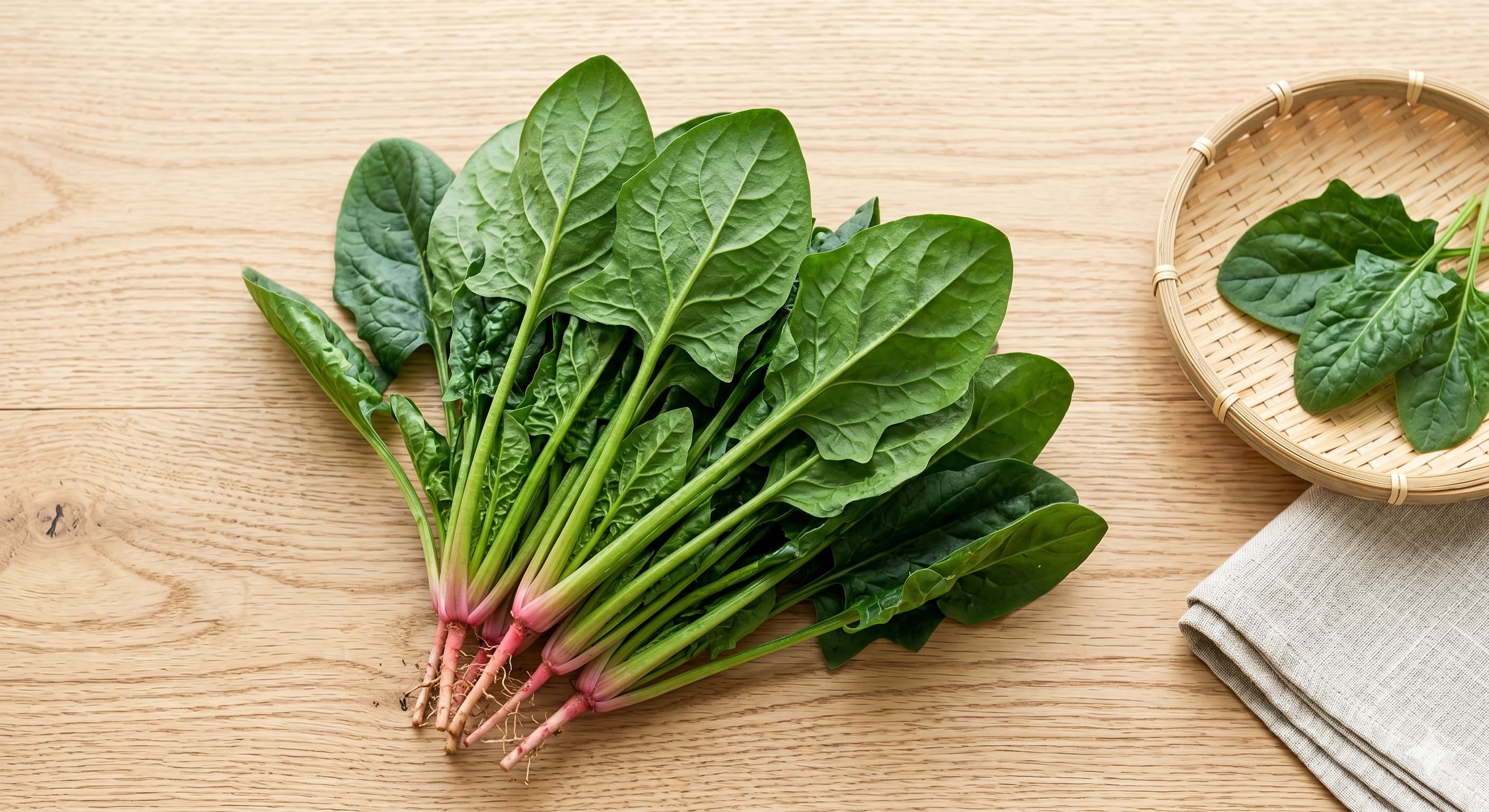
Spinach
Spinacia oleracea
Spinach traveled one of the longest culinary journeys of any vegetable. Originating in ancient Persia (Iran), it moved east through Nepal to China during the Tang Dynasty (7th century), which is why its classical Chinese name 菠薐草 literally means 'Persian grass.' From China, it reached Korea, where it became so deeply integrated into the cuisine that most Koreans today consider it a native vegetable. The Korean name 시금치 may derive from the slightly tart (시큼한) taste of its red root. In Korean cooking, sigeumchi-namul is often the very first dish a new cook learns to make — its simplicity is deceptive, as mastering the 30-second blanch and the gentle hand-mixing with sesame oil teaches the foundational instincts of Korean cuisine. Historically, spinach was valued as a spring tonic after long winters of eating preserved and fermented foods, its cool nature believed to clear accumulated winter heat from the body.
New to Spinach?
Is this edible?
Yes! Spinach is one of the most universally eaten vegetables in Korea, appearing at nearly every meal as a side dish. Korean spinach is tender, sweet, and gentle — even children love it.
What does it taste like?
Similar to baby spinach but slightly sweeter and more tender, with none of the metallic aftertaste that mature Western spinach can have.
Where to buy
Any supermarket carries spinach. For the authentic Korean experience with red-tinged roots, check Korean grocery stores (H Mart, Lotte) or farmers markets. Baby spinach from any store works well too.
How to prepare
Wash thoroughly in several changes of water to remove sand. Blanch in boiling water for just 20-30 seconds (do not overcook!), then immediately plunge into ice water. Squeeze out excess water gently before seasoning.
Pro tip: Keep the red root attached — it is the sweetest, most nutritious part and adds beautiful color. The 30-second blanch is everything: even 10 seconds too long makes it mushy.
Traditional Medicine
Source: Donguibogam (동의보감)
Nature (性)
Cool (涼)Flavor (味)
sweet
Target Organs (歸經)
Liver (肝), Heart (心)
Benefits
- circulation
Opens the blood vessels and dissolves stagnant blood, promoting healthy circulation
혈맥을 통하게 하고 어혈을 풀어준다
Source: 동의보감 [탕액편] 채부
- eye health
Nourishes liver blood to brighten the eyes — in Korean medicine, the liver governs vision
간혈을 보하여 눈을 밝게 한다
Source: 동의보감 [외형편] 안문
- digestion
Opens the intestines and stomach, aids digestion, and benefits all five organs
장위를 열어 소화를 도우며 오장을 이롭게 한다
Source: 동의보감 [탕액편] 채부
Key Compounds
This information is based on traditional Korean medicine texts (Donguibogam) and is for cultural reference only. It does not constitute medical advice.
Seasonal Availability
Korean spring spinach (March-May) is prized for its tender sweetness. Autumn spinach (October-November) develops deeper flavor from cool nights. Winter greenhouse spinach is available but less flavorful. The red-rooted Korean variety (포항초) is considered the finest.
Complementary Ingredients (궁합 재료)
The archetypal Korean pairing — nutty sesame oil amplifies spinach's mild sweetness and aids absorption of its fat-soluble vitamins
Spinach and tofu in doenjang soup is a classic combination; the cool spinach balances tofu's neutral nature
Together in bibimbap, their contrasting textures (silky vs. crunchy) create a complete vegetable harmony
Processing Methods (법제)
Brief blanching (under 30 seconds) reduces oxalic acid that can block calcium absorption while preserving nutrients and bright green color. Always rinse in cold water immediately after.
Consumption Tips by Health Goal
Eye health
Blanch lightly and dress with sesame oil to enhance absorption of fat-soluble lutein and beta-carotene. Eat regularly as a side dish.
Blood circulation
Consume the whole plant including the red root, which is richest in iron and flavonoids. The red root is traditionally considered the most medicinal part.
Digestion
Eat as a gentle side dish (namul) when recovering from illness. Its cool nature soothes an overheated stomach without burdening digestion.
Culinary Profile
Flavor
Mild, slightly sweet with gentle earthy undertones; Korean spinach tends to be more tender and sweeter than Western varieties, especially the spring harvest
Texture
Silky-soft when blanched; the stems retain a pleasant, slight crunch that contrasts with the tender leaves
Common Uses
Western Substitutes
Related Recipes
Classic Tofu Dressed Vegetables (Shira-Ae)
기본 시라아에
Easy | 60 min
Bibimbap
비빔밥
Medium | 50 min
Temple-style Bibimbap
사찰식 비빔밥
Medium | 55 min
Mayak Gimbap (Addictive Mini Rice Rolls)
마약김밥
Easy | 35 min
Yasik Gimbap (Classic Vegetable Rice Rolls)
야채김밥
Medium | 55 min
Kkoma Gimbap (Baby Rice Rolls)
꼬마김밥
Easy | 40 min
Spinach Rice Porridge
시금치죽
Hard | 0 min
Gluten-Free Spinach Rice Muffins
시금치 쌀 머핀
Easy | 80 min
Cauliflower and Komatsuna Miso Soup
콜리플라워 코마츠나 된장국
Easy | 20 min
Jerusalem Artichoke and Komatsuna Miso Soup
뚱딴지 코마츠나 된장국
Easy | 20 min
Malabar Spinach Miso Soup
쓰루무라사키 된장국
Easy | 10 min
Kabocha and Rice Dumpling Hoto-Style Stew
단호박 시라타마 호토풍
Easy | 30 min
Lotus Root and Spinach Jeon with Nuts
연근 시금치 전
Easy | 80 min
Glass Noodle Stir-fry
잡채
Medium | 35 min
Royal Court Japchae
궁중 잡채
Hard | 60 min
Yasai Ramen (Vegetable Ramen)
야사이 라멘 (채소 라멘)
Medium | 55 min
Yasai Udon (Japanese Vegetable Udon Soup)
야사이 우동 (채소 우동)
Easy | 25 min
Korean Seasoned Spinach
시금치나물
Easy | 10 min
Royal Court Five-Color Namul
궁중 오색나물
Medium | 45 min
Spinach Namul with Gochujang
시금치나물 무침
Easy | 15 min
Tofu & Spinach Salad
두부 시금치무침
Easy | 20 min
Horenso no Gomaae (Spinach with Sweet Sesame Dressing)
호렌소 고마에 (시금치 참깨무침)
Easy | 10 min